Last Updated: May 2026
How to Use BLS Data and Job Postings to Negotiate Your Nurse Salary in 2026
The Problem
Most nurses walk into salary negotiations with no data. HR departments walk in with spreadsheets. That gap costs nurses $5,000–$15,000/year — money that compounds every year you stay at that employer. This guide closes the gap: here is exactly where to get the data, how to read it, and how to use it in a real conversation.

Salary negotiation advice for nurses is everywhere. Most of it tells you to “know your worth” without explaining where to find that number. The Bureau of Labor Statistics publishes the most comprehensive public wage dataset in the country — updated annually, broken down by state, metro area, and occupation. Job posting salary ranges, mandated by pay transparency laws in a growing number of states, add a second data layer. Combined, these two sources give you everything you need to anchor any salary conversation in market reality rather than guesswork.
Step 1: Pull Your BLS Benchmark
The BLS Occupational Employment and Wage Statistics (OEWS) program publishes wages for every major occupation in every state and metropolitan statistical area. For registered nurses, the SOC code is 29-1141. The most recent data covers May 2024 wages (published April 2025).
Go to bls.gov/oes → “Data” → “Occupational Employment Statistics” → search for SOC 29-1141 → filter by your state and metro area. You will see the 10th, 25th, 50th (median), 75th, and 90th percentile wages. The 75th percentile is your target — that is what experienced, specialty-trained nurses in your market earn. If you are being offered the median or below as an experienced nurse, you have a documented, sourced number to challenge it with.
US RN Salary Benchmarks — BLS OEWS May 2024
| Percentile | Annual Salary | Hourly Rate |
|---|---|---|
| Median US RN salary (BLS May 2024) | $89,010/yr | $42.79/hr |
| 25th percentile (entry/mid market) | $72,200/yr | $34.71/hr |
| 75th percentile (experienced/specialty) | $106,530/yr | $51.22/hr |
| 90th percentile (senior/high-cost market) | $130,050/yr | $62.52/hr |
Source: Bureau of Labor Statistics OEWS May 2024, SOC 29-1141 Registered Nurses
Step 2: Adjust for Your Specialty
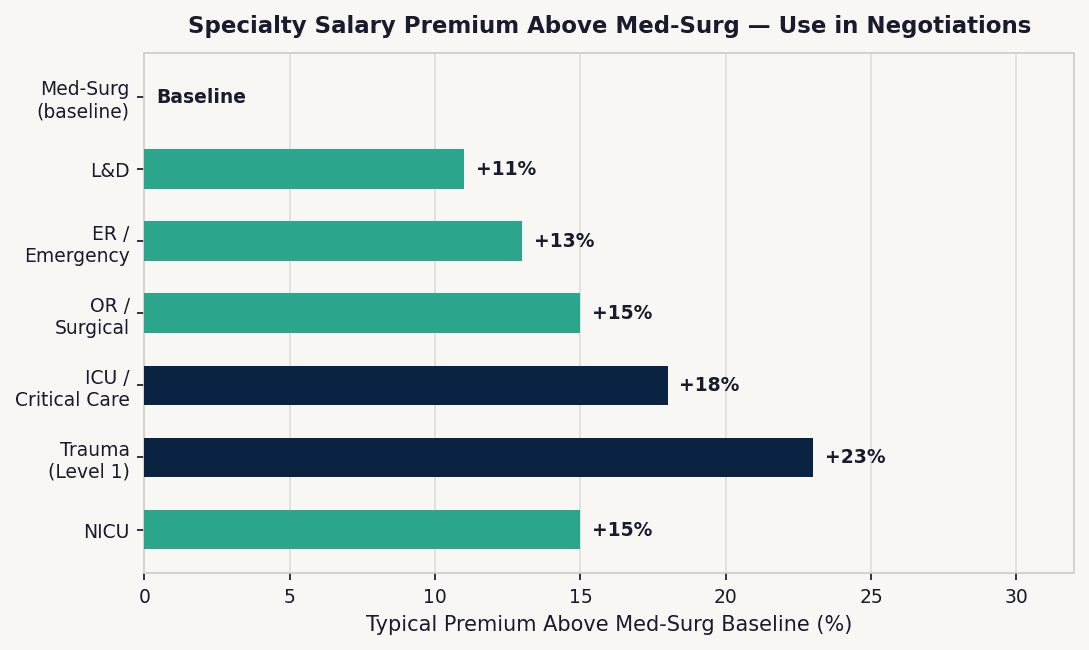
BLS state and metro figures blend all RN specialties together — meaning a Med-Surg nurse and an ICU nurse are averaged into the same number. If you work in a high-demand specialty, you should be earning meaningfully above the published median. Use the adjustments below as a starting point for your specific specialty premium, then validate against job posting ranges in your market.
Typical Specialty Premium Over Med-Surg Baseline
| Specialty | Typical Premium | Context |
|---|---|---|
| Med-Surg (baseline) | 0% | Reference rate |
| ICU / Critical Care | +15–22% | Most markets |
| OR / Surgical | +12–18% | Most markets |
| L&D | +8–14% | Most markets |
| ER / Emergency | +10–16% | Most markets |
| Trauma (dedicated units) | +18–28% | Level 1 centers |
| NICU | +12–18% | Most markets |
Source: NurseSalaryIntel 2026 specialty analysis based on BLS OEWS and market data
Step 3: Search Job Postings for Real Ranges

Pay transparency laws now require salary ranges in job postings across California, Colorado, New York, Washington, Illinois, and a growing list of other states. Even where not legally required, many hospital systems have started posting ranges voluntarily. This gives you real market data — not survey estimates — from the actual employers competing for your skills.
Search Indeed or LinkedIn for your role + city. Filter to postings with salary ranges. Look at 10–15 postings from comparable employers. Note the floor, ceiling, and midpoint. If your current employer is offering you the floor while competitors are posting the ceiling, that gap is your negotiating document. Print it. Bring it to the conversation.
“If what you're asking for is realistic, what's wrong with showing that you value yourself enough to ask for a little? If you're going to ask for more, you'd better have a response to tell them why you deserve it and look them straight in the eye, don't bat an eye, and tell them exactly how amazing you are.”
Step 4: Factor in Cost of Living — Not Just Gross Salary
A $90,000 offer in Houston and a $90,000 offer in San Francisco are not equivalent. Texas has no income tax; California takes 9.3% on that bracket. Houston median rent runs $1,300/month; San Francisco runs $3,200+. After taxes and housing, the Houston offer leaves you with substantially more money.
When comparing offers across cities — or deciding whether to relocate — run a cost-of-living adjusted comparison. The formula is simple: take your gross salary, subtract federal tax (approximately 22% bracket for most nurses), state income tax (0–9.9% depending on state), and local income tax (0–3.2%), then subtract annualized housing cost. What remains is your real annual purchasing power. That number is what you should be comparing, not the headline salary.
Step 5: Put It All Together in the Conversation
The most effective salary negotiation scripts are short and specific. Vague asks get vague answers. Compare these two approaches:
Weak:“I was hoping for a little more based on my experience.”
Strong:“The BLS OEWS data for this metro puts the 75th percentile for experienced ICU nurses at $102,000. I've also looked at three current postings from comparable hospitals in this area — they're ranging from $98,000 to $108,000. My current offer is $88,000. Based on my seven years of ICU experience and CCRN certification, I'm asking for $97,000.”
The second version is harder to dismiss because it is grounded in public data, not personal feeling. HR can argue with your sense of your own worth. They cannot easily argue with the Bureau of Labor Statistics.
What to Do If They Say No
A no to base salary is not always a no to total compensation. If an employer cannot move on base, ask about: sign-on bonus structure and vesting timeline, shift differential rates (nights, weekends), tuition reimbursement annual cap, additional PTO accrual for experienced hires, and specialty certification pay ($1–$3/hr for CCRN, CEN, TNCC, and similar credentials). These levers are often more flexible than base salary because they come from different budget lines.
If they cannot move on anything — and the gap between their offer and your data is material — that is useful information too. It tells you the employer is either budget-constrained or not willing to compete for talent. Both are worth knowing before you sign.
Related Guides
Nurse Salary Negotiation Guide 2026
Full negotiation framework and scripts
RN Salary by State
Your BLS benchmark by state
RN Salary by Experience Level
How pay grows year by year
How We Calculate Salary Estimates
Our data methodology explained
📊 Data Methodology
Salary figures on this page are 2026 estimates derived from the most recent available U.S. Bureau of Labor Statistics Occupational Employment and Wage Statistics (OEWS) data, based on the May 2024 survey and published in March 2025. Estimated ranges may also incorporate publicly available 2025 job postings, hospital pay schedules, regional market conditions, and reported compensation trends.
Official 2026 OEWS wage data has not yet been released. All salary figures on this page should be treated as informational estimates rather than official government statistics or guaranteed compensation rates.
Frequently Asked Questions
Where can nurses find reliable salary data for negotiating?
How do I calculate what I should be making as a nurse?
Is it OK to ask for more than the posted salary range?
What data sources should I use before negotiating a travel nurse contract?
Should I mention a competing offer when negotiating my nurse salary?
Download your free nursing contract audit kit — scripts, checklists, and counter-offer language
- ✓ Word-for-word counter-offer emails for each red flag clause
- ✓ Scripts for negotiating with recruiters by phone
- ✓ Legal addendum language to modify bad clauses
- ✓ What to say if they push back or say "it's standard"
Instant access · Free · No credit card