Last Updated: April 2026
RN Salary by Years of Experience 2026: Full Career Pay Trajectory
Quick Answer
RN salary grows from $62,000–$88,000 as a new grad to $108,000–$140,000 at 15+ yearswithout advanced practice credentials. The fastest growth comes in years 3–5 with specialty certification (CCRN, CEN adding $4K–$7K/year) and shift differential adoption. APRN credentials (NP, CRNA) break the staff RN ceiling, reaching $120,000–$250,000+.
Understanding how RN salary grows with experience is essential for both career planning and negotiation. Unlike many professions, nursing has multiple inflection points where the right move — a certification, a specialty switch, a shift change, or an advanced degree — can add $10,000–$50,000 to annual compensation almost immediately.

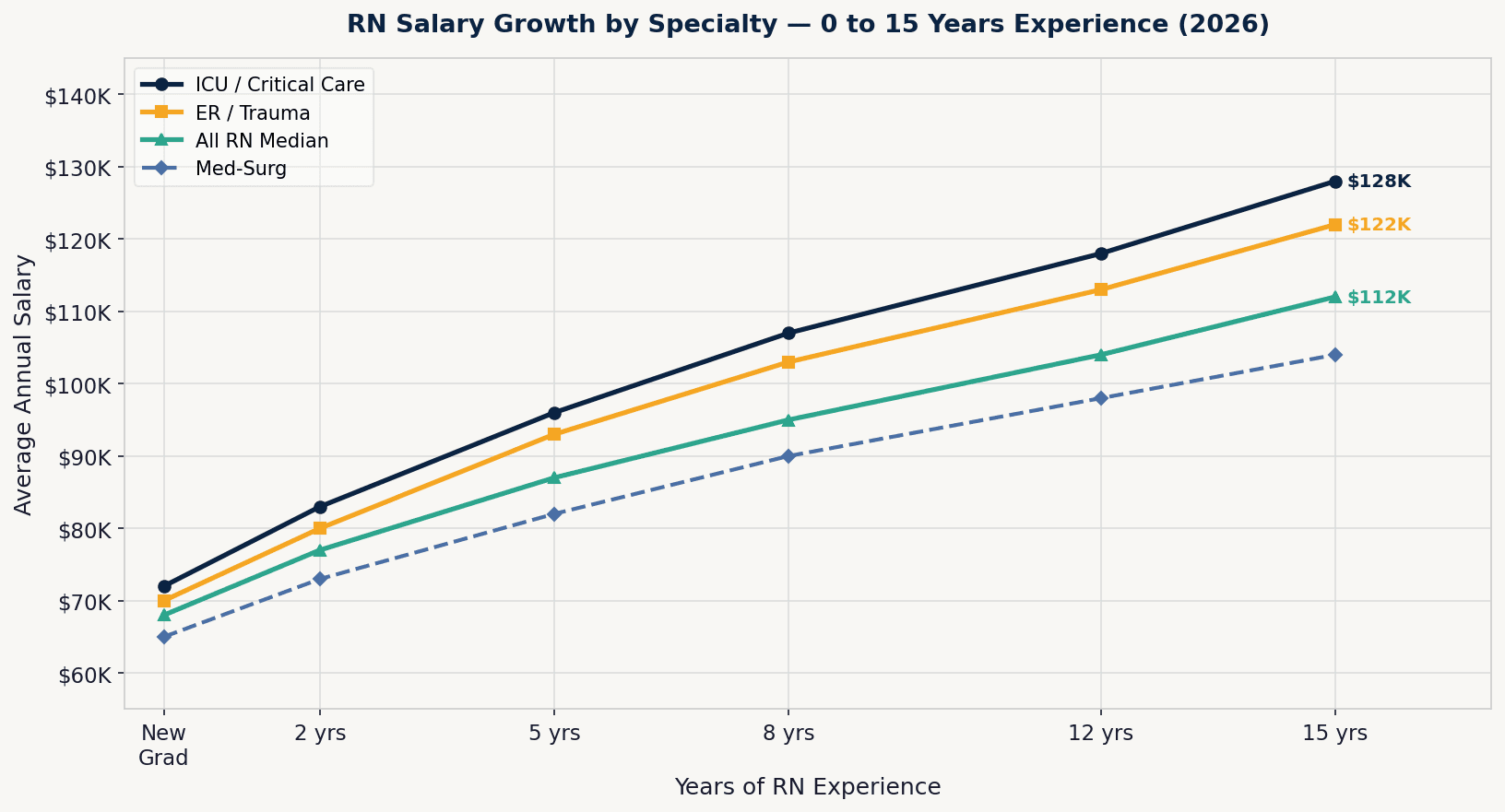
RN Salary by Years of Experience — National Average (2026)
RN Salary Growth by Years of Experience (2026)
| Experience Level | Typical Salary Range | Key Milestone |
|---|---|---|
| Year 1 (New Grad) | $62,000–$88,000 | Orientation / residency phase |
| Year 2 | $70,000–$94,000 | First step increase, off orientation |
| Year 3 | $76,000–$100,000 | Specialty focus, first cert eligible |
| Year 4–5 | $82,000–$108,000 | CCRN/CEN adds $4K–$7K |
| Year 6–7 | $88,000–$116,000 | Preceptor/charge eligibility |
| Year 8–10 | $94,000–$124,000 | Senior staff, lead RN roles |
| Year 10–15 | $100,000–$134,000 | Educator, CNS, charge nurse |
| Year 15+ (no APRN) | $108,000–$140,000 | Peak staff RN earning zone |
| APRN (NP, CRNA, CNS) | $120,000–$250,000+ | Advanced practice ceiling |
Source: BLS OEWS 2025 + NurseSalaryIntel 2026 career trajectory data
The Three Fastest Pay-Growth Inflection Points
Most nurses see their fastest salary acceleration at three specific moments in their career:
- Year 3–4: First specialty certification. CCRN, CEN, CNOR, and RNC-OB certifications add $4,000–$8,000/year and unlock charge nurse eligibility at most facilities. The exam costs $200–$400 and the ROI is typically under 3 months.
- Year 2–5: Shifting to nights. A 15% night differential on a $90,000 base adds $13,500/year — no new credential required. See the night shift nurse salary guide for the full math.
- Year 5–8: Moving to charge or preceptor. Charge differentials of $2–$5/hr add $4,000–$10,000/year and build the leadership experience needed for educator and management roles.
RN Salary by Specialty at 5 and 10 Years
RN Salary by Specialty — 5 and 10 Year Benchmarks (2026)
| Specialty & Experience | Salary Range | Notes |
|---|---|---|
| ICU — 5 years (CCRN) | $96,000–$118,000 | Night shift adds $10K–$18K |
| ICU — 10 years (CCRN) | $114,000–$136,000 | Charge/lead adds $4K–$8K |
| ER — 5 years (CEN) | $92,000–$112,000 | Trauma cert adds $3K–$5K |
| ER — 10 years (CEN) | $108,000–$128,000 | Level 1 trauma premium |
| OR — 5 years (CNOR) | $90,000–$110,000 | Call pay adds $8K–$15K |
| L&D — 5 years (RNC-OB) | $86,000–$106,000 | On-call premium significant |
| Med-Surg — 5 years | $76,000–$94,000 | Charge adds $4K–$6K |
| Home Health — 5 years | $68,000–$84,000 | Lower ceiling vs acute care |
Source: NurseSalaryIntel specialty salary data, 2026
RN Salary by Experience and State
5-Year ICU RN Salary by State (CCRN, 2026)
| State / Benchmark | Salary Range | Notes |
|---|---|---|
| California — 5 yrs ICU | $118,000–$136,000 | Union contract step schedule |
| Washington — 5 yrs ICU | $108,000–$126,000 | UW Medicine / Providence |
| New York — 5 yrs ICU | $102,000–$118,000 | NYC academic centers |
| Texas — 5 yrs ICU | $88,000–$104,000 | No income tax advantage |
| Florida — 5 yrs ICU | $82,000–$98,000 | No income tax; lower base |
| National Avg — 5 yrs ICU | $96,000–$118,000 | CCRN assumed |
Source: BLS OEWS 2025 + NurseSalaryIntel 2026 state projections
When Experience Stops Mattering (and What to Do)
Staff RN salary plateaus typically hit between years 12 and 18. Union hospitals with defined step schedules continue increasing pay through step 20+ in some contracts — California union RNs may not fully plateau until year 20–25. Non-union hospitals in most states plateau by year 10–12.
At that point, the options that meaningfully reset the ceiling are: APRN education (NP, CRNA, CNS — see the CRNA salary guide for CRNA ROI math), moving into nursing management or education (adds $10,000–$25,000/year for experienced nurses), or maximizing travel nursing income while maintaining staff employment.
Related Salary Guides
New Grad RN Salary 2026
First-year pay and how to maximize it
Charge Nurse Salary 2026
The $4K–$10K experience milestone
CRNA Salary 2026
Breaking the staff RN ceiling with CRNA
Salary Negotiation Scripts
Use experience to negotiate higher pay
Sources
- BLS OEWS — Registered Nurses, National and State Data
- AACN — Nursing Workforce Fact Sheet
- National Council of State Boards of Nursing (NCSBN)
📊 Data Methodology
Salary figures on this page are 2026 estimates derived from the most recent available U.S. Bureau of Labor Statistics Occupational Employment and Wage Statistics (OEWS) data, based on the May 2024 survey and published in March 2025. Estimated ranges may also incorporate publicly available 2025 job postings, hospital pay schedules, regional market conditions, and reported compensation trends.
Official 2026 OEWS wage data has not yet been released. All salary figures on this page should be treated as informational estimates rather than official government statistics or guaranteed compensation rates.
Frequently Asked Questions
How much does RN salary increase per year of experience?
What is the average RN salary with 5 years of experience?
At what point does RN salary plateau?
How much more do certified nurses earn than non-certified?
Does the type of employer affect how fast RN salary grows?
Download your free nursing contract audit kit — scripts, checklists, and counter-offer language
- ✓ Word-for-word counter-offer emails for each red flag clause
- ✓ Scripts for negotiating with recruiters by phone
- ✓ Legal addendum language to modify bad clauses
- ✓ What to say if they push back or say "it's standard"
Instant access · Free · No credit card