Last Updated: May 2026
30% of Nurses Never Negotiate Salary — Here's What the Data Says to Do

Quick Answer
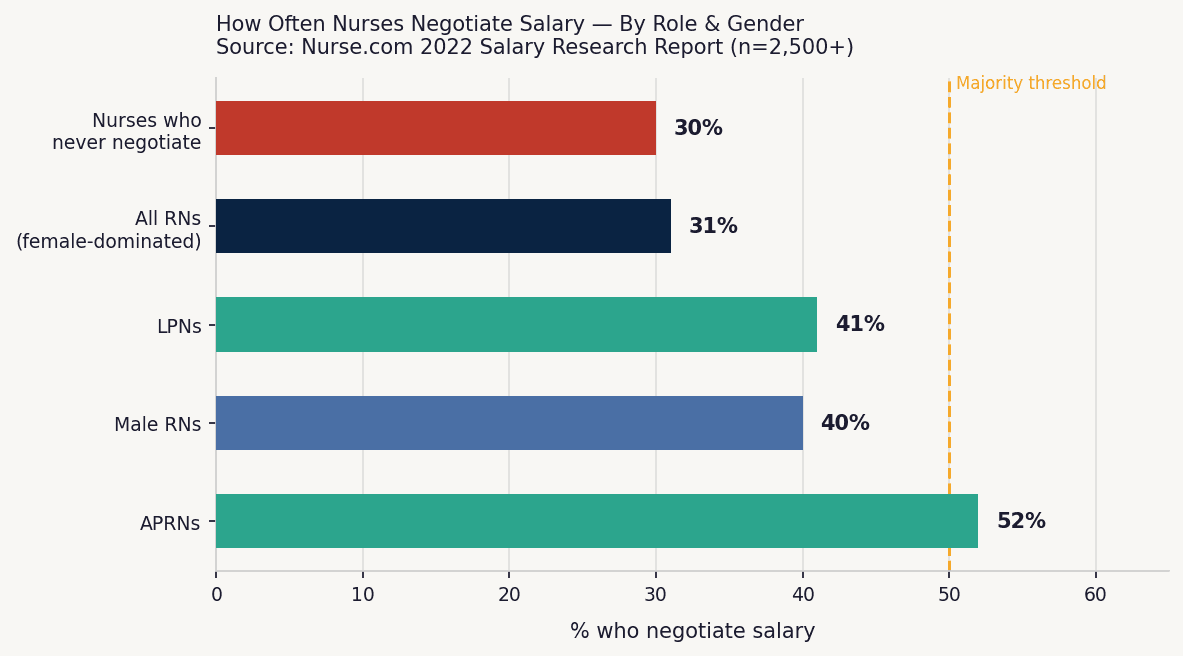
Only 18% of RNs always negotiate salary when starting a new job, according to a Nurse.com survey of more than 2,500 nurses. About 30% never negotiate at all. The nurses most likely to negotiate — APRNs at 52% — also tend to earn the most. The tactics that consistently work: research the pay structure before the conversation, document your certifications and charge-level experience, and ask specifically rather than generally.
Most nurses rank salary as the number one factor in job satisfaction. Yet when the offer arrives, a third of them sign without asking for anything more. That gap costs real money — not just on the first paycheck, but compounded across every raise and step increase that follows.
What the Survey Data Actually Shows
In late 2021, Nurse.com surveyed more than 2,500 nurses across all 50 states. The 2022 Salary Research Report that followed is one of the most detailed looks at how nurses actually engage with compensation — and the findings are striking.
- Only 18% of RNs said they always negotiate salary at each new job
- 30% of all nurses surveyed said they never negotiate
- APRNs negotiate most — 52% said they do so all or most of the time
- LPNs: 41% negotiate; male RNs: 40%
- Only 31% of female RNs said they negotiate always or most of the time
The gender gap is worth pausing on. Female nurses — who make up roughly 87% of the RN workforce — negotiate at meaningfully lower rates than their male counterparts. That's not a critique; it's a pattern shaped by decades of the "just a nurse" narrative. Nurse coach Keith Carlson, BSN, RN, NC-BC, has heard that phrase from countless clients: "'Just' is a four-letter word when you're talking about yourself as a nurse because it's diminishing. It makes you smaller." (Indeed, Dec 2025)
Why Most Bedside Nurses Think They Can't Negotiate (And When That's Actually Wrong)
The most common reason nurses don't try: they assume the pay is fixed. And for some employers, it genuinely is. Jessica Quezada Jackson, CHCR, a talent acquisition recruiter and board member at the National Association for Health Care Recruitment (NAHCR), explains how clinical ladder systems work: "Many employers pay nurses based on level of experience, with tiers built in for certifications, higher degrees, and more. It's not really a negotiation, but rather a set, tiered pay structure."
But here's where nurses leave money on the table: the tier you're placed on often depends on what you tell the recruiter — not what's on your resume alone. Theresa Mazzaro, RN, CHCR, a senior talent acquisition specialist at Suburban Hospital (Johns Hopkins Medicine) and NAHCR board member, puts it directly: "From a negotiation standpoint, it would behoove nurses to be able to tell their stories about the experiences of jobs they've had and what they've done. Because if we're looking at just a resume and that's the only snapshot we have when we're calculating a salary, we might not have the whole picture." (Nurse.com)
Translation: the number on your offer letter often isn't the ceiling — it's what the recruiter could calculate from your paperwork. If your resume doesn't mention that you precepted eight new grads, ran charge 40% of your shifts, or hold a CCRN, you may have been placed in a lower tier than your experience warrants.

What Is Actually Negotiable in a Nursing Offer
The answer varies by employer, but the range is broader than most nurses realize. Even when base pay is locked into a grid, experienced recruiters routinely have flexibility on:
| Compensation Element | Negotiability | Notes |
|---|---|---|
| Base hourly rate | Medium — depends on pay grid | More flexible at small practices and non-acute settings than large hospital systems |
| Sign-on bonus | Often flexible | Amount and vesting period are frequently negotiable, especially for specialty or hard-to-fill units |
| Night/weekend differential | Usually fixed | Set by policy, but you can negotiate which shifts you are assigned |
| Charge/preceptor differential | Ask about eligibility | If you have charge experience, confirm you qualify from day one — don't assume |
| Tuition reimbursement | Often negotiable | Cap amounts and eligible programs can vary by negotiation |
| Relocation assistance | High for relocating nurses | Particularly flexible in underserved areas and rural markets |
| PTO accrual | Moderate | Some employers will match your existing accrued PTO balance when switching jobs |
| Shift preference | High | If not specified in the posting, requesting 12-hour shifts vs. 8-hour is a reasonable ask |
For new graduates specifically: base pay negotiation is rarely an option, but sign-on bonuses, relocation, and shift preference conversations are worth having. Jackson confirms: "Nurses can get that information through their recruiters. A lot of recruiters are in-house, and they'll be able to tell you what you're going to make based on your background." The ask doesn't need to be combative — a direct question to the recruiter about what flexibility exists is entirely professional.
Three Moves That Consistently Work
1. Tell the full story, not just the job title
Recruiters calculate salary offers from what's documented. If your resume says "ICU RN, 4 years" and nothing else, they'll slot you at the standard 4-year tier. But if you also carried charge responsibilities 35% of your shifts, precepted six new grads, and hold a CCRN — that's a different tier at many institutions. Mazzaro's advice: before the offer conversation, prepare a short verbal summary of the experience your resume doesn't capture. Write it on a notecard. Use it.
2. Ask specifically, not vaguely
Vague asks — "Is there any flexibility?" — get vague answers. Specific asks get real responses. Keith Carlson's framing: "If what you're asking for is realistic, what's wrong with showing that you value yourself enough to ask for a little? They might ask you, 'What would merit us paying you $76,000 instead of $70,000 a year? What do you bring to the table?' If you're going to ask for more, you'd better have a response." Come in with a number and a reason. "Given my five years of ICU experience and CCRN certification, I was expecting something closer to $42/hr — is that achievable?" is a better opener than "I was hoping for a little more."
3. Negotiate after the written offer, before you sign
Timing is everything. Bringing up compensation in the first interview puts you at a disadvantage — the employer hasn't committed to you yet. Once you have a written offer, the dynamic shifts. They've decided you're their candidate. That's the moment to negotiate. Per the Indeed/Carlson piece: the average U.S. annual salary increase is around 4.2%, meaning accepting a starting salary 10% below your target can take over two years to recover even with strong reviews.
When the Employer Says No
Rejection isn't the end of the conversation. A few practical moves:
- Ask what would make you eligible for a higher tier at the 6-month mark. Get the criteria in writing. That becomes your roadmap.
- Negotiate non-cash items. If base pay is genuinely fixed, a sign-on bonus, extra PTO week, or tuition reimbursement boost can be worth several thousand dollars annually.
- Ask about performance review timing. Some employers offer reviews at 90 days rather than 12 months for strong candidates. That's a salary increase cycle you can negotiate upfront.
- Get anything discussed in writing. Verbal promises during hiring are hard to enforce once you start. If they offer something informally, ask for it in the offer letter.
Building Negotiating Power Before You Need It
The nurses with the most leverage in any salary conversation are the ones who made moves before the conversation started. Mazzaro's top recommendations for stacking your case:
- Certifications. CCRN, CEN, CNOR, PCCN — these credentials don't just signal competence, they often trigger a differential or higher placement on a pay grid. "Getting that certification shows and proves via an evaluation and exam that you are competent and certified as a specialty nurse," Mazzaro says.
- Charge and preceptor experience. "Anytime that you increase your level of responsibility, like with being a preceptor or a charge nurse, there's typically a differential for that." Carry charge whenever you can — even sporadically — and put it on your resume.
- Degree level. Hospitals often pay a differential for BSN over ADN. If your employer offers tuition reimbursement, ask specifically what the BSN pay differential is and factor that into your decision to pursue it.
- Documentation of your wins. Keep a running log of measurable accomplishments: patient satisfaction scores you influenced, committees you led, codes you ran. This becomes your negotiation evidence at your annual review or your next offer conversation.
What This Means for Your Next Offer
The 30% of nurses who never negotiate aren't leaving a little on the table — they're leaving compounding salary growth on the table. A $3/hr difference at the start of a career, at 4.2% annual raises, compounds into a six-figure earnings gap over 20 years. The clinical ladder systems at large hospital systems aren't designed to overpay you. They're designed to pay you what's documented.
Document more. Tell the story your resume doesn't. Ask specifically. Ask after the written offer. And if you're told the base is fixed — there are usually eight other things on the offer sheet worth discussing.
Frequently Asked Questions
Can RNs negotiate salary?
Yes — though the room for negotiation depends on the employer's pay structure. Experienced RNs, APRNs, and nurses moving to new employers typically have the most leverage. New grads often face fixed pay grids, but can still negotiate sign-on bonuses, shift differentials, and PTO.
What percentage of nurses negotiate salary?
According to Nurse.com's 2022 Salary Research Report (more than 2,500 nurses surveyed), only 18% of RNs always negotiate at each new job. About 30% never negotiate at all. APRNs are most likely to negotiate (52%), followed by LPNs (41%) and male RNs (40%).
What is negotiable in a nursing job offer beyond base salary?
Beyond base pay, nurses can often negotiate sign-on bonus amounts and vesting timelines, tuition reimbursement caps, relocation assistance, PTO accrual rates, shift preferences, and charge or preceptor differential eligibility.
When is the best time for a nurse to negotiate salary?
After you receive a written offer but before you sign. At that point, the employer has committed to hiring you, giving you maximum leverage. Waiting until after you sign eliminates most negotiating power.
Related Guides
📊 Data Methodology
Salary figures on this page are 2026 estimates derived from the most recent available U.S. Bureau of Labor Statistics Occupational Employment and Wage Statistics (OEWS) data, based on the May 2024 survey and published in March 2025. Estimated ranges may also incorporate publicly available 2025 job postings, hospital pay schedules, regional market conditions, and reported compensation trends.
Official 2026 OEWS wage data has not yet been released. All salary figures on this page should be treated as informational estimates rather than official government statistics or guaranteed compensation rates.
Sources: Nurse.com 2022 Salary Research Report (more than 2,500 RN respondents) · Nurse.com, "Nurse Recruiters Share Top Tips" (Theresa Mazzaro, RN, CHCR; Jessica Quezada Jackson, CHCR — NAHCR board members) · Indeed Career Guide, Keith Carlson BSN, RN, NC-BC (updated Dec 2025) · U.S. Bureau of Labor Statistics OEWS May 2024
Frequently Asked Questions
Can RNs negotiate salary?
What percentage of nurses negotiate salary?
What is negotiable in a nursing job offer beyond base salary?
When is the best time for a nurse to negotiate salary?
Download your free nursing contract audit kit — scripts, checklists, and counter-offer language
- ✓ Word-for-word counter-offer emails for each red flag clause
- ✓ Scripts for negotiating with recruiters by phone
- ✓ Legal addendum language to modify bad clauses
- ✓ What to say if they push back or say "it's standard"
Instant access · Free · No credit card