Last Updated: May 2026
How NurseSalaryIntel Calculates Nurse Salary Estimates
The Short Version
Every salary figure on this site starts with BLS OEWS data— the U.S. government's official occupational wage survey. We cross-reference those figures against publicly available job postings and hospital pay schedules, apply regional market adjustments, and label the result a 2026 estimate— not official data, not a guarantee. Official 2026 BLS data won't exist until early 2027.

Salary data is only useful if you know where it comes from and what it can't tell you. This page explains exactly how we build every estimate on NurseSalaryIntel — the sources we use, the adjustments we make, and where the limitations are. If something looks off on any page, this is the methodology you should hold us to.
Step 1: Start With BLS OEWS Data
Our foundation is the Bureau of Labor Statistics Occupational Employment and Wage Statistics (OEWS) program. BLS surveys approximately 1.1 million business establishments every May, collecting wage data for more than 800 occupations across every state and metropolitan area in the US. For nursing, the relevant occupation codes are:
- SOC 29-1141 — Registered Nurses (the primary code for RN salary data)
- SOC 29-1171 — Nurse Practitioners
- SOC 29-1151 — Nurse Anesthetists (CRNAs)
- SOC 29-2061 — Licensed Practical and Licensed Vocational Nurses (LPN/LVN)
- SOC 31-1131 — Nursing Assistants (CNAs)
The most recent OEWS data available is the May 2024 survey, published March 2025. BLS releases each year's data approximately 10 months after the survey period. Official 2025 OEWS data is not yet published as of May 2026; 2026 data will not be available until early 2027. This is why every page on this site labels figures as 2026 estimates rather than official 2026 data.
Step 2: Cross-Reference Public Job Postings
BLS OEWS data is comprehensive but lags by 10–22 months. Active job market conditions — sign-on bonus inflation, new union contracts, system-wide pay raises — won't appear in the data until the next release cycle. To account for this, we review publicly available job postings from major hospital systems, nursing job boards, and hospital careers pages.
When posted salary ranges on current job listings diverge meaningfully from BLS OEWS figures — by more than 5% consistently across multiple postings — we note this in the relevant page and adjust our estimate range accordingly. We do not replace BLS data with job posting data; we use postings as a verification layer and flag significant divergence.
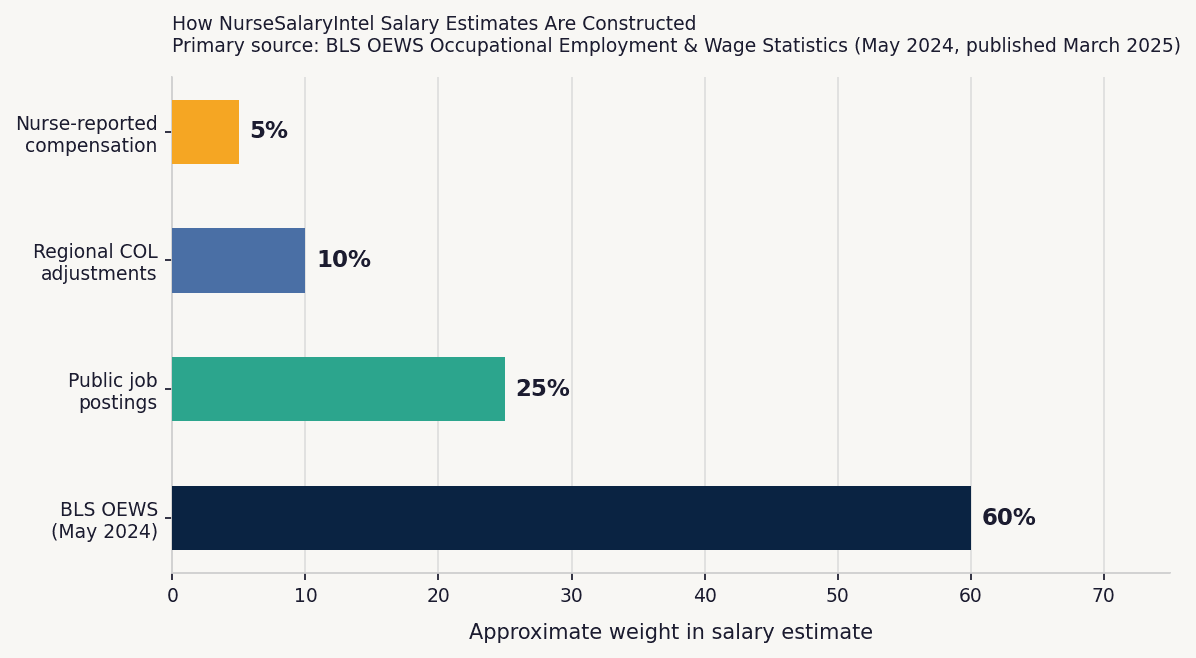
Step 3: Apply Regional Market Adjustments
BLS OEWS publishes metro-level data for large metropolitan statistical areas, but not for every city or suburb. For cities without direct MSA-level BLS data, we use the nearest available MSA figure and apply a regional adjustment based on:
- Cost of living index — sourced from the Council for Community and Economic Research (C2ER)
- State income tax rate — we cite the 2026 rate where available from state revenue departments
- Local healthcare market conditions — presence of major academic medical centers, union activity, shortage designations
- Proximity to higher-paying metro — nurses in satellite suburbs often take small discounts vs. the core metro
Step 4: Incorporate Nurse-Reported Compensation
Where available, we incorporate publicly reported compensation data from nurse surveys and community sources — including published nursing salary surveys from organizations like the American Association of Colleges of Nursing (AACN) and published hospital pay transparency data. This is a supplemental source only — we do not accept unverified anonymous submissions as data inputs.

What Our Estimates Cannot Tell You
Understanding the limitations of any salary data source is as important as the data itself. NurseSalaryIntel estimates should not be used for:
- Specific offer benchmarking without verification. Always confirm with current job postings for the exact unit, system, and shift you are targeting.
- Union contract negotiations. Union pay scales are set by contract and may differ significantly from market estimates. Contact your union directly.
- Legal or financial advice. We are not attorneys, financial advisors, or certified salary consultants. Our data is for informational and career research purposes only.
- Travel nurse package comparison. Travel nurse total compensation (stipends, housing, per diem) does not map cleanly to BLS OEWS figures, which measure W-2 base wages. See our travel nurse salary guide for package-specific guidance.
How to Use These Estimates in Your Career
The most effective use of NurseSalaryIntel data is as a starting point for your own research — not as the final word. Here is the workflow we recommend:
- Use our city and specialty pages to understand the general range for your target market.
- Search active job postings on the careers pages of specific hospitals you are targeting to see posted ranges.
- Check Glassdoor and Indeed salary data for nurse-reported figures at your specific employer.
- Ask your recruiter directly what the pay grid looks like for your experience level and unit.
- Use our negotiation guide to understand what is typically flexible and how to ask for more.
Frequently Asked Questions
Where does NurseSalaryIntel get its salary data?
Our primary source is the U.S. Bureau of Labor Statistics Occupational Employment and Wage Statistics (OEWS) program, specifically the May 2024 survey data published in March 2025. We cross-reference BLS figures against publicly available job postings, hospital pay schedules, and regional market conditions to produce 2026 estimates.
Is the 2026 BLS nurse salary data available yet?
No — official BLS OEWS 2026 data has not been published. BLS releases OEWS data approximately 10 months after the May survey period, meaning 2026 data will not be available until early 2027. All salary figures on this site are 2026 estimates derived from the most recent available data (May 2024, published March 2025).
How accurate are your salary estimates?
Our estimates are designed to be directionally accurate for compensation research and career planning. They should not be treated as guaranteed compensation rates or official government statistics. Individual offers will vary significantly by hospital, unit, shift, negotiation, certifications, and years of experience. Always verify with actual job postings and your recruiter.
Do your salary figures include shift differentials and bonuses?
Base salary estimates reflect base hourly and annual pay only, unless otherwise noted. Shift differentials, sign-on bonuses, overtime, and per-diem pay are discussed separately in relevant articles. Total compensation can be 15–35% higher than base salary when these elements are included.
How often do you update salary data?
We update pages when new BLS OEWS data is released (typically annually in March), when significant market shifts occur, or when job posting data indicates notable deviation from BLS figures. Each page displays a "Last Updated" date. Pages marked May 2026 reflect our most current estimates.
Related Pages
About NurseSalaryIntel
Our team and editorial mission
Full Salary Data Hub
All nurse salary data by state
Nurse Salary Negotiation Guide
How to use data in a real negotiation
RN Salary by State
All 50 states with BLS sourcing
📊 Data Methodology
Salary figures on this page are 2026 estimates derived from the most recent available U.S. Bureau of Labor Statistics Occupational Employment and Wage Statistics (OEWS) data, based on the May 2024 survey and published in March 2025. Estimated ranges may also incorporate publicly available 2025 job postings, hospital pay schedules, regional market conditions, and reported compensation trends.
Official 2026 OEWS wage data has not yet been released. All salary figures on this page should be treated as informational estimates rather than official government statistics or guaranteed compensation rates.
Primary data source: U.S. Bureau of Labor Statistics OEWS May 2024 survey, published March 2025 · American Association of Colleges of Nursing (AACN) · Council for Community and Economic Research (C2ER) cost of living data.
Frequently Asked Questions
Where does NurseSalaryIntel get its salary data?
Is the 2026 BLS nurse salary data available yet?
How accurate are your salary estimates?
Do your salary figures include shift differentials and bonuses?
How often do you update salary data?
Download your free nursing contract audit kit — scripts, checklists, and counter-offer language
- ✓ Word-for-word counter-offer emails for each red flag clause
- ✓ Scripts for negotiating with recruiters by phone
- ✓ Legal addendum language to modify bad clauses
- ✓ What to say if they push back or say "it's standard"
Instant access · Free · No credit card