RN Salary Calculator 2026
Estimate your nursing take-home pay after federal taxes, state taxes, FICA, and pre-tax deductions — with optional night shift differential and overtime.

Your Pay Details
2026 IRS limit: $23,000. Pre-tax reduces federal + state taxable income.
Typical range: 10–20% for nights. Enter 0 if day shift only.
Deduction Breakdown
Disclaimer: This calculator provides estimates for planning purposes only. It does not account for city/local taxes (e.g., Philadelphia 3.79%, NYC 3.876%), deferred compensation, HSA contributions, disability insurance, or other payroll deductions. Consult a tax professional for personalized guidance.
How to Use This Calculator
Enter your base salary, select your state, and adjust pre-tax deductions to see your estimated annual, monthly, and bi-weekly take-home. The calculator accounts for federal marginal tax brackets, state income tax rates, FICA (Social Security + Medicare), and pre-tax deductions that reduce your taxable income.
Shift differential: If you work nights, enter your differential as a percentage of base pay (e.g., 15% for a 15% night differential). The calculator adds that to your gross before calculating taxes — because differential pay is fully taxable.
Overtime: Enter your average overtime hours per week. The calculator adds 0.5× your hourly rate for each OT hour (assuming you're already compensated 1× through your regular schedule).
States With No Income Tax — Worth Knowing
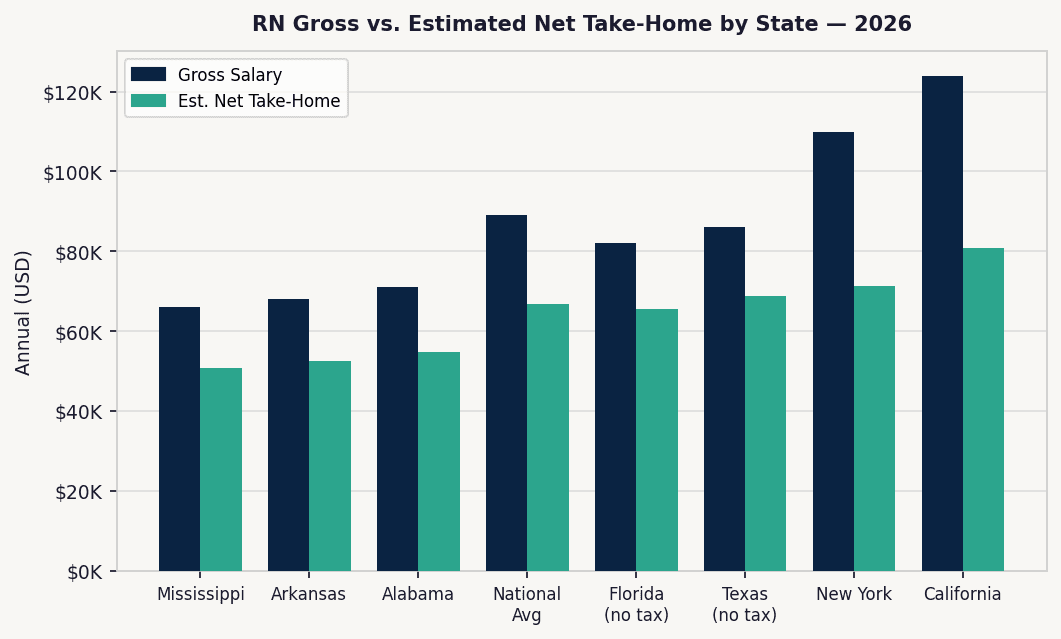
Nine states have no state income tax: Alaska, Florida, Nevada, New Hampshire, South Dakota, Tennessee, Texas, Washington, and Wyoming. For a nurse earning $89,000, moving from California (effective ~8.5% state rate) to Texas means approximately $7,500–$9,000/year more in take-home pay for the same gross salary — equivalent to a substantial raise.
That said, total compensation matters more than tax savings alone. A California Kaiser nurse earning $140,000 under a CNA contract takes home more after California's high taxes than a Texas non-union nurse earning $90,000 tax-free. See our hospital salary comparison to benchmark your offer against what comparable hospitals pay in your market.