Travel Nurse Pay Calculator 2026
Estimate your take-home pay for any travel nurse contract — including tax-free stipends, blended hourly rate, and net weekly income after federal, state, and FICA taxes. Compare two contracts side by side.

📊 Quick Estimate
A typical 13-week ICU travel contract at $24/hr taxable + $1,365/wk in stipends in a no-income-tax state yields approximately $2,097/week take-home and a $61.92/hr blended rate. Adjust the inputs below for your specific contract.
Your Contract Details
Typical range: $18–$35/hr. Does not include stipends.
GSA lodging rates: $800–$1,500/wk depending on city.
GSA M&IE rates: $280–$420/wk. Tax-free with qualifying tax home.
Taxable. Often split — half on start, half on contract completion.
Pre-tax. 2026 IRS limit: $23,000. Many travel agencies offer limited matching.
Stipends are tax-free when you maintain a bona fide primary residence.
Pay Breakdown
How Your Travel Nurse Pay Is Calculated
Travel nurse compensation has two distinct components: a taxable hourly wage (typically $18–$35/hr) and tax-free stipends for housing and meals and incidentals. The taxable wage is subject to federal income tax, state income tax, and FICA. Stipends are reimbursements — not wages — and are not subject to any income tax as long as you maintain a qualifying tax home and are working away from it on assignment.
The blended rate — total weekly compensation divided by contracted hours — is the number to use when comparing contracts or benchmarking against staff RN pay. A contract at $24/hr taxable with $1,365/wk in stipends on a 36-hour week works out to roughly $61.92/hr blended. That is the apples-to-apples number.
Tax-Free Stipends: What Counts and What Doesn't
The IRS allows travel nurses to receive housing and meals stipends tax-free under IRC §162 — but only if you maintain a bona fide tax home. A tax home is your principal place of business or regular workplace. If you own or rent a residence you return to regularly and can demonstrate genuine ongoing housing costs there, your stipends are tax-free on assignment.
If you don't have a qualifying tax home — for example, you gave up your apartment and travel full-time — the IRS treats all compensation as taxable income. This can cost $15,000–$25,000/year in additional taxes depending on your stipend level and state. Always work with a tax professional who specializes in travel healthcare workers before accepting your first contract.

Which States Pay Travel Nurses the Most After Taxes?
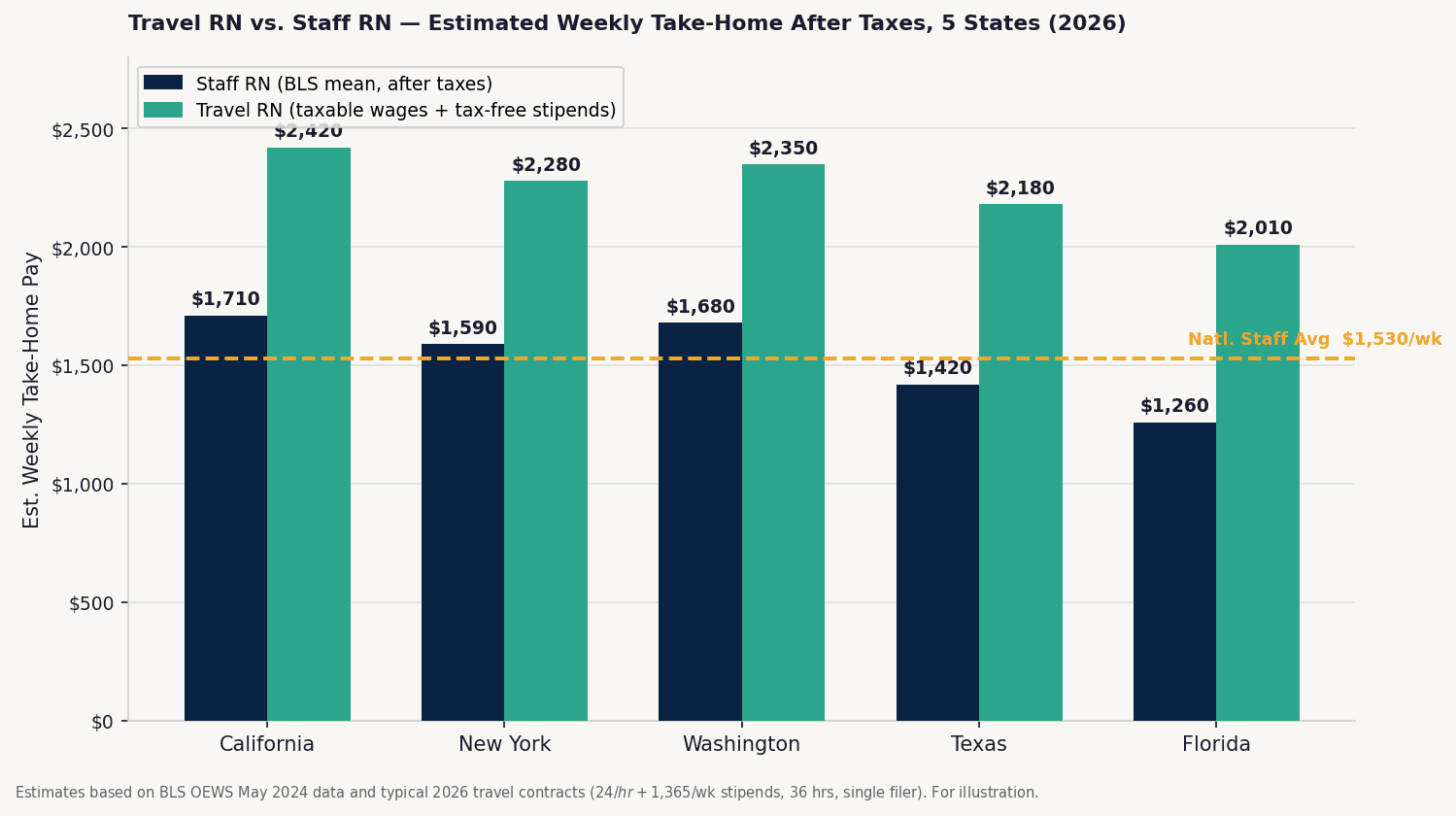
Your assignment state affects take-home in two ways: the going contract rates in that market, and the state income tax applied to your taxable wages. The nine states with no income tax — Alaska, Florida, Nevada, New Hampshire, South Dakota, Tennessee, Texas, Washington, and Wyoming — add $1,500–$5,000+ to your net take-home on a 13-week contract compared to a high-tax state like California or Oregon.
That said, California and Washington typically offer the highest total packages due to strong nursing unions and high regional demand — even after taxes, ICU travel contracts in San Francisco or Seattle often clear $2,400–$3,000/week net. The calculator accounts for state income tax automatically when you select your assignment state.
Frequently Asked Questions
What is a blended rate for travel nurses?
A blended rate divides your total weekly compensation — taxable wages plus tax-free stipends — by your contracted hours. It is the most useful number for comparing contracts because a lower taxable hourly rate with generous stipends can easily outpay a higher taxable rate with no housing allowance. To calculate it: (weekly taxable wages + weekly stipends) ÷ contracted hours per week.
Are travel nurse stipends tax-free?
Yes — housing and meals stipends are exempt from federal and state income tax, and from FICA, as long as you maintain a qualifying tax home and are working away from it on assignment. If you do not have a qualifying tax home (e.g., you gave up your residence and travel full-time), all compensation becomes taxable income.
How much do travel nurses make per week after taxes in 2026?
Most travel RNs clear $1,800–$3,200/week after taxes in 2026, depending on specialty, assignment location, and whether they qualify for tax-free stipends. ICU and OR travelers in high-demand markets like California or Washington typically land at the higher end. Use this calculator with your contract details for a personalized estimate.
How do I compare two travel nurse contracts?
Calculate the blended rate for each contract: add total weekly taxable wages + weekly stipends, then divide by contracted hours. Also consider contract length, assignment city cost of living, overtime availability, and agency reputation. The comparison tool above runs both contracts side by side and identifies the better offer.
Does this calculator account for city and local taxes?
No — this tool estimates state-level income tax only. If your assignment is in a city with a local income tax (New York City adds 3.876%, Philadelphia adds 3.79%, San Francisco adds 1.5%), your actual take-home will be lower. Account for local taxes manually or consult a travel nurse tax specialist.
Related Salary Tools & Guides
📊 Data Methodology
Salary figures on this page are 2026 estimates derived from the most recent available U.S. Bureau of Labor Statistics Occupational Employment and Wage Statistics (OEWS) data, based on the May 2024 survey and published in March 2025. Estimated ranges may also incorporate publicly available 2025 job postings, hospital pay schedules, regional market conditions, and reported compensation trends.
Official 2026 OEWS wage data has not yet been released. All salary figures on this page should be treated as informational estimates rather than official government statistics or guaranteed compensation rates.
Sources & Methodology
Stipend rates based on U.S. General Services Administration (GSA) lodging and M&IE per diem rates for 2026. Tax calculations use IRS 2026 federal income tax brackets and FICA rates. State income tax rates derived from 2026 published state tax schedules. Travel nurse taxable wage ranges sourced from publicly available job postings verified March–May 2026. All estimates are informational and do not constitute tax or financial advice.