Last Updated: May 2026
Shift Differential Nurse Pay 2026: How Much Night and Weekend Shifts Actually Add to RN Salary
The Numbers Up Front
Night shift differential adds $4–$12/hr to base RN pay depending on the system and market. For a full-time night nurse working 36 hours/week, that is $7,200–$21,600/year in additional gross pay — before stacking specialty differential or weekend premium. Shift differential is the most overlooked lever in nurse compensation, and it is completely invisible in the headline salary numbers most nurses compare.

When nurses compare salaries — between jobs, between cities, between Reddit posts — they almost always compare base pay. That comparison misses the most variable and often most significant component of actual take-home pay: shift differential. A nurse earning $72,000 base on nights with a $7/hr differential is actually earning $84,600 in gross annual pay. A nurse at a higher-paying hospital earning $78,000 base on days is earning $78,000. The night nurse is earning more — but the base salary comparison makes it look the opposite.
Night Shift Differential Rates by Hospital Type (2026)
Nurse Night Shift Differential Rates by Hospital Category
| Hospital Type | Differential Rate | Annual Impact (36hr/wk) |
|---|---|---|
| Community hospital (low-cost market) | $3.00 – $5.00/hr | $5,400 – $9,000/yr (36hr/wk) |
| Regional medical center (mid market) | $4.50 – $7.00/hr | $8,100 – $12,600/yr |
| Major academic / Level 1 (high market) | $6.00 – $10.00/hr | $10,800 – $18,000/yr |
| Union contracts (CA, NY, WA, OR) | $8.00 – $12.00/hr | $14,400 – $21,600/yr |
| Weekend differential (any shift) | $2.00 – $5.00/hr | Stacked on night diff for Sat/Sun nights |
Source: NurseSalaryIntel 2026 market data
Real Differential Rates at Major Systems (2026)
Union contracts consistently produce the highest differential rates. The California Nurses Association, Washington State Nurses Association, Oregon Nurses Association, and New York State Nurses Association all negotiate night differentials that are meaningfully above what non-union systems pay in the same markets. This is one of the clearest financial arguments for union employment that shows up in actual paycheck data.
Night Shift Differential at Major Hospital Systems
| Hospital System | Night Differential Rate | Notes |
|---|---|---|
| OHSU (Portland, OR) | $8.50 – $11.00/hr night | Union CBA; weekend adds $4.00 |
| UW Medical Center (Seattle, WA) | $8.00 – $10.50/hr night | WSNA union contract |
| Cleveland Clinic (OH) | $3.50 – $6.50/hr night | Non-union; policy-based |
| Johns Hopkins (Baltimore, MD) | $4.50 – $7.00/hr night | Varies by unit and shift window |
| HCA Healthcare (multiple) | $3.00 – $5.50/hr night | Varies by market — $3–$5.50/hr |
| Kaiser Permanente (CA/OR/WA) | $7.00 – $12.00/hr night | Union; among highest in country |
Source: NurseSalaryIntel 2026 data from job postings, union CBAs, and nurse-reported figures
How Differential Stacks: Night + Specialty + Weekend

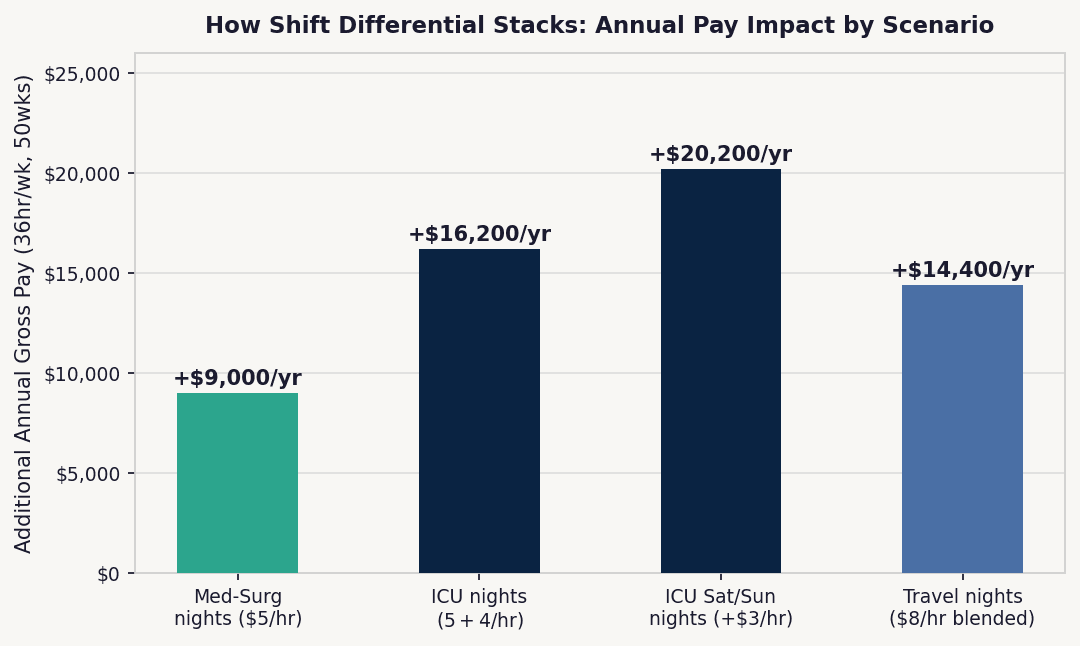
Most discussions of shift differential treat it as a single number. In practice, multiple differentials stack — and the total effect on annual pay is significant. An ICU nurse working Saturday and Sunday nights might receive: base ICU specialty differential ($3–$5/hr) + night differential ($5–$8/hr) + weekend differential ($2–$4/hr). That is $10–$17/hr above base pay on those two shifts.
Stacked Differential Annual Impact Scenarios
| Scenario | Additional Annual Pay | Notes |
|---|---|---|
| Med-Surg nights (36hr/wk, $5/hr diff) | +$9,000/yr | Differential only |
| ICU nights (36hr/wk, $5/hr diff + $4/hr ICU) | +$16,200/yr | Night + specialty stacked |
| ICU weeknight (Sat/Sun, $5/hr + $3/hr wknd) | +$20,200/yr | Night + specialty + weekend |
| Travel nurse nights (blended, $8/hr diff) | +$14,400/yr | Contract varies; verify taxable split |
Source: NurseSalaryIntel 2026 scenario analysis
Why This Changes How You Should Compare Offers
When evaluating a new position, the total compensation comparison needs to account for differential eligibility, not just base pay. Ask every employer these specific questions before comparing offers:
What is your night differential rate (7pm–7am)? Get the exact dollar amount, not a percentage — percentages applied to different bases produce different dollar outcomes. When does differential apply during orientation? Some systems pay day rates during a 6–12 week orientation even if you are hired for nights — a real income loss for night nurses. Is weekend differential paid in addition to night differential or instead of it? Stacked is the better structure. Does specialty certification add an additional hourly premium? Many systems pay $1–$3/hr extra for CCRN, CEN, TNCC, or similar credentials, applied to every shift.
Negotiating Differential at Hire
The differential rate itself is usually fixed by policy or contract and not individually negotiable. What is often negotiable: your starting step on the base pay scale (a higher step means a higher base from which differential is calculated), the length of your orientation period on day rates, and whether your sign-on bonus is structured to cover the income gap during orientation. Experienced night nurses should always ask: “Is there any flexibility on the orientation period length given my experience, or on day rates during orientation?” Many systems have discretion on this that is not offered unless asked.
A pattern that comes up repeatedly in nurse salary discussions: orientation periods that default to day rates cost night-shift hires $2,000–$4,000 in lost differential income over a 10–12 week orientation. Many nurses don't know this is negotiable until their second or third job. At systems with any flexibility, asking specifically about orientation structure — and whether night differential applies during training — costs you nothing and can meaningfully change your first-year take-home pay.
Related Guides
Night Shift Differential Pay Rates
Full breakdown of rates by hospital and state
Using Data to Negotiate Your Salary
BLS data + job postings as your negotiation toolkit
Nurse Salary Negotiation Guide 2026
Full framework and scripts
RN Salary by State
Base pay benchmarks for all 50 states
📊 Data Methodology
Salary figures on this page are 2026 estimates derived from the most recent available U.S. Bureau of Labor Statistics Occupational Employment and Wage Statistics (OEWS) data, based on the May 2024 survey and published in March 2025. Estimated ranges may also incorporate publicly available 2025 job postings, hospital pay schedules, regional market conditions, and reported compensation trends.
Official 2026 OEWS wage data has not yet been released. All salary figures on this page should be treated as informational estimates rather than official government statistics or guaranteed compensation rates.
Frequently Asked Questions
How much is shift differential for nurses in 2026?
How much does night shift add to an RN annual salary?
Is shift differential negotiable?
Do travel nurses get shift differential?
What is the difference between night differential and weekend differential?
Download your free nursing contract audit kit — scripts, checklists, and counter-offer language
- ✓ Word-for-word counter-offer emails for each red flag clause
- ✓ Scripts for negotiating with recruiters by phone
- ✓ Legal addendum language to modify bad clauses
- ✓ What to say if they push back or say "it's standard"
Instant access · Free · No credit card