Last Updated: May 2026
RN Salary by Years of Experience 2026: How Nurse Pay Grows at Every Career Stage
Quick Answer
New grad RNs earn $62,000–$70,000 nationally in 2026. By year 5 with specialty experience, that grows to $78,000–$91,000. Senior nurses with 10+ years reach $99,000–$121,000+. The fastest path to six figures: ICU or OR specialty + night shift + certification — achievable in 4–5 years in most markets, 3 years in California.

The national average registered nurse salary of approximately $89,000/year (BLS OEWS May 2024) obscures a wide range that depends heavily on where you are in your career. A nurse with 1 year of med-surg experience and a nurse with 12 years of ICU experience are both captured in that average — but their actual salaries are separated by $40,000–$50,000. Understanding how pay grows — and what drives the biggest jumps — is the most actionable career planning tool available to nurses at any stage.
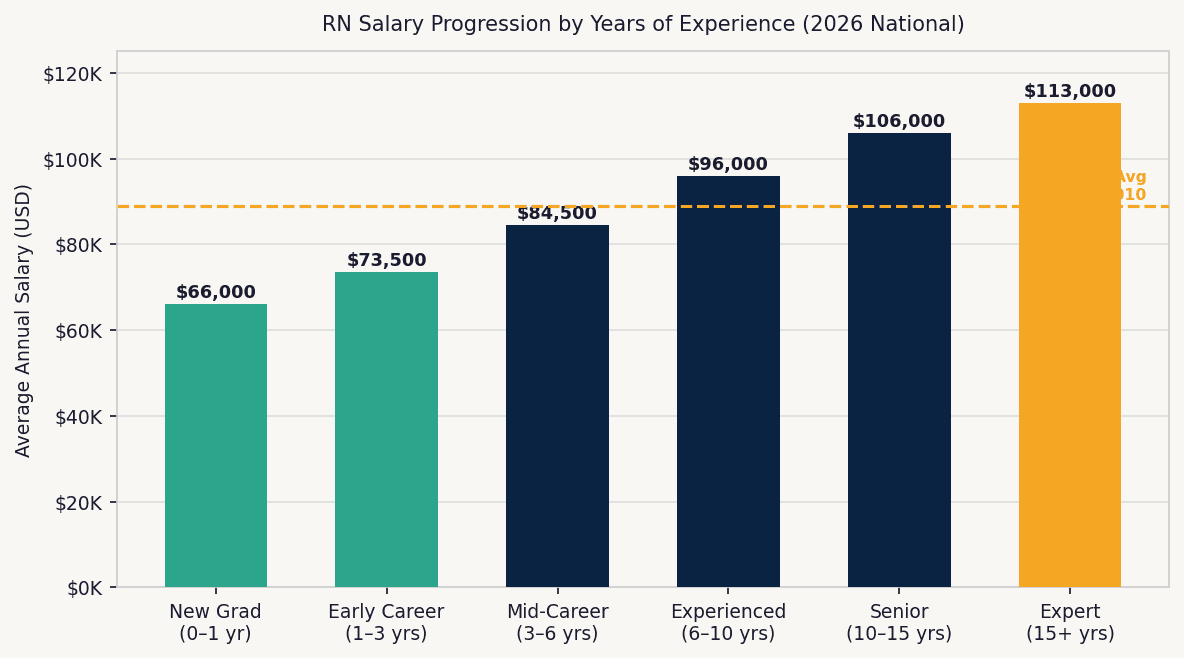
RN Salary by Years of Experience (2026 National)
The data below represents national median salary ranges by experience tier, based on BLS OEWS occupational wage data and NurseSalaryIntel analysis of pay scale structures across acute care hospital systems. Figures reflect base salary only — shift differentials, overtime, and certification stipends are additive.
Registered Nurse Salary by Experience Level (2026)
| Experience Tier | Annual Salary Range | Hourly Rate |
|---|---|---|
| New Grad / Year 1 (0–1 yr) | $62,000 – $70,000 | $29.80 – $33.65/hr |
| Early Career (1–3 yrs) | $68,000 – $79,000 | $32.70 – $38.00/hr |
| Mid-Career (3–6 yrs) | $78,000 – $91,000 | $37.50 – $43.75/hr |
| Experienced (6–10 yrs) | $88,000 – $104,000 | $42.30 – $50.00/hr |
| Senior (10–15 yrs) | $97,000 – $115,000 | $46.60 – $55.30/hr |
| Expert (15+ yrs) | $105,000 – $121,000+ | $50.50 – $58.20+/hr |
Source: BLS OEWS May 2024 + NurseSalaryIntel experience-tier analysis
Where the Salary Jumps Are — and Why
Nurse pay doesn't grow linearly. There are two inflection points where salary accelerates meaningfully. The first is the transition from new grad to established staff nurse at roughly years 2–3. Most hospital systems run step-based pay scales where years 1–2 are locked into lower steps, and then nurses advance 2–3 steps at the annual review cycle. This typically adds $4,000–$7,000 in one move.
The second inflection — often the bigger one — happens between years 4–7 when specialty certifications and demonstrated critical care experience open doors to charge positions, clinical ladder advancement, and traveler-competitive offers. A nurse who earns CCRN at year 4 and moves to a Level 1 trauma ICU has crossed a salary threshold that a med-surg nurse with 10 years of experience often hasn't.
RN Salary by Specialty + Experience Combination

Experience years alone don't determine salary — specialty matters as much as tenure. The table below shows realistic salary ranges when experience and specialty intersect, including the certification premium where applicable.
RN Salary by Specialty + Experience Level (2026)
| Specialty + Experience | Annual Salary Range | Notes |
|---|---|---|
| Med-Surg, 0–3 yrs | $62,000 – $74,000 | Entry specialty; common residency path |
| ICU, 3–5 yrs + CCRN | $88,000 – $104,000 | +CCRN adds $4,680–$9,360/yr |
| ER, 3–6 yrs + CEN | $85,000 – $100,000 | CEN adds ~$4,800/yr avg |
| OR / Surgical, 4–8 yrs | $88,000 – $106,000 | CNOR premium + on-call pay |
| L&D, 4–8 yrs | $84,000 – $102,000 | Specialty demand driven |
| Charge RN, 5–10 yrs | $95,000 – $115,000 | +$3–$5/hr charge stipend |
| Travel Nurse, 2+ yrs | $95,000 – $155,000 | Contract-dependent; $2,400–$3,200/wk |
Source: NurseSalaryIntel 2026 market data + specialty certification survey analysis
Fastest Paths to Six Figures for RNs
Six-figure nursing salaries are real and achievable — they require deliberate choices in specialty, shift, and market. The table below shows the combinations most likely to clear $100,000/year, with approximate timelines.
Fastest Paths to $100K+ for RNs (2026)
| Path | Realistic Salary Range | Key Notes |
|---|---|---|
| ICU + CCRN + nights (year 4) | $98,000 – $110,000 | Base + cert + differential stacked |
| OR + CNOR + call pay (year 5–6) | $100,000 – $118,000 | Call pay adds $10K–$18K/yr |
| Travel ICU/ER (year 2–3) | $100,000 – $145,000 | Contract pay; verify taxable split |
| Charge RN + nights (year 5–7) | $100,000 – $120,000 | Leadership + differential combined |
| Any specialty in CA + nights | $110,000 – $140,000+ | Union pay floor + high differentials |
Source: NurseSalaryIntel 2026 compensation analysis
Experience vs. Market: Which Matters More?
A critical care nurse with 5 years of experience earns roughly $92,000–$104,000 nationally — but that same nurse earns $112,000–$125,000 in Seattle and potentially $118,000–$135,000 in San Francisco. The market multiplier on experience is the largest variable in nursing compensation planning. For nurses who are geographically flexible, the highest-leverage move is often relocation to a high-paying compact state market combined with specialty certification — not simply waiting for years to accumulate.
California, Washington, New York, and Massachusetts consistently pay the highest nominal salaries at every experience level. Texas, Florida, and Indiana offer stronger real purchasing power relative to cost of living. The optimal choice depends on personal circumstances — but the math should be run explicitly, not assumed.
What Actually Drives the Biggest Pay Increases
Across all experience levels, the most powerful salary levers available to nurses are: specialty change (moving from med-surg to ICU or OR), shift change (adding consistent night differential worth $7,000–$18,000/year), certification (adding $4,000–$12,000 through CCRN, CEN, CNOR, or CRNFA), and market change (relocating to a higher-paying metro or accepting a travel contract). Any one of these can outpace 3–5 years of step-based pay increases. Combining two or more — a mid-career nurse moving to nights in ICU with CCRN in a strong market — can add $25,000–$40,000 to annual income in a single year.
Related Salary Guides
Shift Differential Pay 2026
Night shift adds $8K–$25K/yr
ICU Nurse Salary 2026
Critical care pay + CCRN premium
Nurse Salary Negotiation Guide
How to use experience as leverage
RN Salary by State
Base pay benchmarks for all 50 states
Sources
- BLS OEWS — Registered Nurses, National and State Data (May 2024)
- American Association of Colleges of Nursing — Nursing Workforce Data
- SHRM — Merit Pay and Step Increase Structures
📊 Data Methodology
Salary figures on this page are 2026 estimates derived from the most recent available U.S. Bureau of Labor Statistics Occupational Employment and Wage Statistics (OEWS) data, based on the May 2024 survey and published in March 2025. Estimated ranges may also incorporate publicly available 2025 job postings, hospital pay schedules, regional market conditions, and reported compensation trends.
Official 2026 OEWS wage data has not yet been released. All salary figures on this page should be treated as informational estimates rather than official government statistics or guaranteed compensation rates.
Frequently Asked Questions
How much does nurse salary increase with experience?
How long does it take a nurse to reach $100K?
Does nursing experience matter more than education for salary?
What is the salary difference between a new grad RN and a 10-year RN?
Does CCRN certification significantly increase salary?
Download your free nursing contract audit kit — scripts, checklists, and counter-offer language
- ✓ Word-for-word counter-offer emails for each red flag clause
- ✓ Scripts for negotiating with recruiters by phone
- ✓ Legal addendum language to modify bad clauses
- ✓ What to say if they push back or say "it's standard"
Instant access · Free · No credit card