Last Updated: May 2026
Charge Nurse Salary vs Staff RN: What the Differential Actually Pays in 2026
Quick Answer
The national average charge nurse differential is $3/hr — adding around $5,600/year on a 36-hour schedule. ICU and ER charge nurses earn the most: $9,500–$10,000 more per year than their staff RN peers. Med-surg charge differentials average just $4,500/year. Whether taking the role is worth it depends entirely on the unit, the facility, and whether you negotiate.

What We Found: The Charge Nurse Pay Gap Is Real — But Wildly Uneven
The charge nurse role carries genuine responsibility: staffing decisions, bed management, conflict resolution, and being the first call when something goes wrong. The pay premium for that responsibility ranges from $1.50/hr at an understaffed community hospital to $6/hr at a unionized academic medical center — a difference of nearly $9,000/year for the same job title.
The data below comes from BLS OEWS May 2024 RN baseline wages plus reported charge differentials from job postings, union CBAs, and facility-specific salary surveys. Charge nurse is not a separate BLS occupational code — pay is calculated as staff RN base plus the charge differential your facility pays.
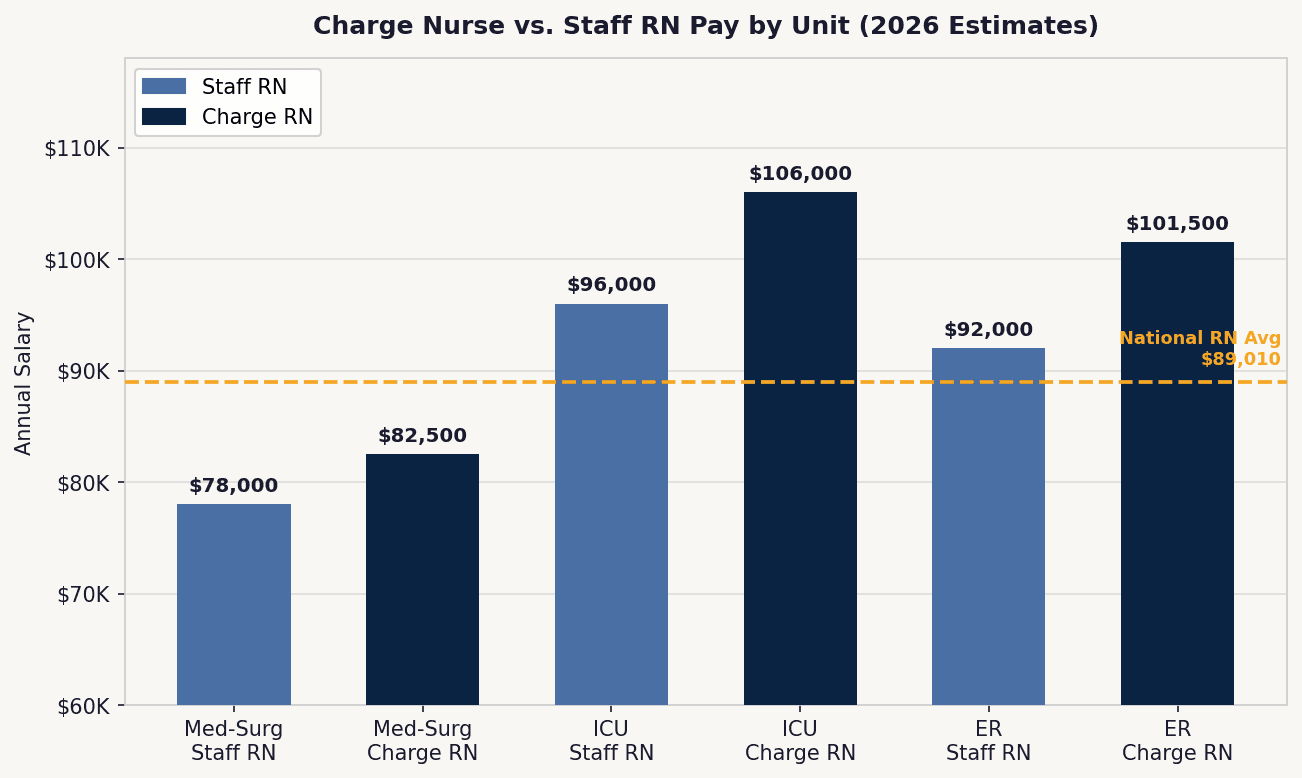
Charge Nurse vs. Staff RN: The Pay Gap by Unit
The size of the premium tracks directly with how much the charge role adds to workload and liability. ICU charge nurses manage the most complex assignments, highest acuity, and most frequent emergencies — and they are compensated accordingly.
Charge Nurse vs. Staff RN Annual Pay by Unit (2026 Estimates)
| Role | Estimated Annual Pay | Annual Premium Over Staff RN |
|---|---|---|
| Med-Surg — Staff RN | $78,000/yr | Baseline |
| Med-Surg — Charge RN | $82,500/yr | +$4,500 (+$2.17/hr) |
| Telemetry — Staff RN | $82,000/yr | Baseline |
| Telemetry — Charge RN | $87,500/yr | +$5,500 (+$2.64/hr) |
| ICU — Staff RN | $96,000/yr | Baseline |
| ICU — Charge RN | $106,000/yr | +$10,000 (+$4.81/hr) |
| ER — Staff RN | $92,000/yr | Baseline |
| ER — Charge RN | $101,500/yr | +$9,500 (+$4.57/hr) |
| L&D — Staff RN | $90,000/yr | Baseline |
| L&D — Charge RN | $97,000/yr | +$7,000 (+$3.37/hr) |
The Differential by Facility Type: Where You Work Matters More Than the Job Title
Two charge nurses working ICU — one at a Magnet academic center, one at a 150-bed community hospital — can earn $4,000–$6,000 more per year at the academic center, even in the same city. Facility type and union status are the biggest variables after specialty.
Charge Nurse Pay Differential by Facility Type
| Facility Type | Typical Differential | Estimated Annual Impact |
|---|---|---|
| Major Academic / Magnet Hospital | $4–$5/hr differential | ~$8,000–$10,000/yr extra |
| Community Hospital (300+ beds) | $2.50–$4/hr differential | ~$5,000–$7,500/yr extra |
| Small Community Hospital (<200 beds) | $1.50–$2.50/hr differential | ~$3,000–$5,000/yr extra |
| Long-Term Care / SNF | $1–$2/hr or flat per-shift | ~$2,000–$4,000/yr extra |
| Unionized Hospitals (CA, NY, WA) | $3–$6/hr differential | ~$6,000–$12,000/yr extra |

Charge Nurse Salary by State
State-level pay follows the same pattern as staff RN wages — California and the Pacific Northwest pay significantly more due to cost of living, union density, and nurse-to-patient ratio laws. The charge differential is layered on top of the state baseline.
Estimated Charge Nurse Salary by State (2026)
| State | Estimated Annual Salary | Estimated Hourly Rate |
|---|---|---|
| California | Around $108,000/yr | ~$51.92/hr |
| New York | Around $93,000/yr | ~$44.71/hr |
| Washington | Around $91,000/yr | ~$43.75/hr |
| Massachusetts | Around $90,000/yr | ~$43.27/hr |
| Oregon | Around $88,000/yr | ~$42.31/hr |
| Colorado | Around $84,000/yr | ~$40.38/hr |
| National Average | Around $83,000–$85,000/yr | ~$40–$41/hr |
| Texas | Around $74,000/yr | ~$35.58/hr |
| Virginia | Around $78,000/yr | ~$37.50/hr |
| Florida | Around $71,000/yr | ~$34.13/hr |
What This Means for Your Negotiation
Most nurses accept the charge differential without question. That is a mistake. Here is what to know before saying yes to the role:
- Ask for the range, not just the number. Facilities almost always have a differential range. If they offer $2/hr, ask if $2.50 or $3 is available. A $0.50/hr difference on a 36-hour schedule is $936/year.
- Clarify whether the differential applies to every charge shift or only some. If your facility charges inconsistently (floating you between charge and staff), a per-shift structure may pay less than an hourly rate applied uniformly.
- Factor in overtime. Charge nurses are typically non-exempt and earn 1.5x their rate (including the differential) for hours over 40. That makes the differential worth more in heavy weeks.
- Evaluate the leadership credit. Even a $2/hr differential at a smaller hospital builds charge nurse experience that qualifies you for nurse manager and director roles — where pay jumps to $95,000–$130,000+ annually. The differential is not the only return.
- Compare to travel nursing. Some experienced charge nurses find that a 13-week travel contract as a staff RN pays more all-in than a permanent charge role at their current facility. Run the numbers before committing.
Frequently Asked Questions
How much more does a charge nurse make than a staff RN?
Charge nurses earn $4,500–$10,000 more per year than staff RNs on the same unit in 2026. The premium is the charge differential — typically $2–$5/hr added to base staff RN pay. ICU and ER charge nurses receive the highest differentials ($4–$5/hr); med-surg and LTC the lowest ($1.50–$2.50/hr).
What is the average charge nurse salary in 2026?
The national average charge nurse salary is around $83,000–$85,000/year ($39–$41/hr) in 2026, based on the BLS OEWS May 2024 RN baseline plus a typical $2.50–$3/hr charge differential. California charge nurses average around $108,000; Florida around $71,000.
What is the charge nurse pay differential?
The charge nurse pay differential averages $3/hr nationally, adding approximately $5,600/year on a 36-hour schedule. Large academic medical centers and Magnet hospitals pay $4–$5/hr; smaller community hospitals may pay $1.50–$2/hr. Unionized hospitals in California, New York, and Washington often pay $4–$6/hr.
Is being a charge nurse worth the extra pay?
It depends on the facility. At well-staffed hospitals, the $3–$5/hr differential plus leadership experience and a faster path to management make it worthwhile. At understaffed units, the added liability and stress may not justify the pay bump — especially at facilities paying only $1.50–$2/hr differential. The leadership experience has real long-term value even if the differential is modest.
Can a charge nurse negotiate a higher differential?
Yes — differentials are often negotiable when accepting the charge role, especially if the hospital is short on experienced charge nurses. Come prepared with data on what comparable facilities pay. A $1/hr increase on a 36-hour schedule is worth $1,872/year. Ask specifically about the range, not just the starting offer.
Do charge nurses get paid more for every shift they charge?
Most hospitals pay the differential only for shifts where you are the designated charge nurse, not on days you work as staff. Some facilities pay a flat per-shift bonus instead of an hourly differential. Clarify this before accepting the role — a per-shift structure can significantly reduce your annual earnings if charge assignments are inconsistent.
Related Guides
Charge Nurse Salary by State
Full state-by-state data table
Nurse Salary Negotiation Guide
Scripts and tactics for any offer conversation
ICU Nurse Salary 2026
Critical care pay + CCRN premium breakdown
ER Nurse Salary 2026
Emergency nursing pay by state and hospital
📊 Data Methodology
Salary figures on this page are 2026 estimates derived from the most recent available U.S. Bureau of Labor Statistics Occupational Employment and Wage Statistics (OEWS) data, based on the May 2024 survey and published in March 2025. Estimated ranges may also incorporate publicly available 2025 job postings, hospital pay schedules, regional market conditions, and reported compensation trends.
Official 2026 OEWS wage data has not yet been released. All salary figures on this page should be treated as informational estimates rather than official government statistics or guaranteed compensation rates.
Sources:
Bureau of Labor Statistics, Occupational Employment and Wage Statistics, May 2024. SOC 29-1141 (Registered Nurses). bls.gov/oes
AACN Nurse Work Environment survey data; union CBA disclosures (California Nurses Association, NYSNA, WSNA); job posting analysis from Indeed and LinkedIn, April–May 2026.
Charge differentials are estimates derived from reported ranges — individual pay depends on facility, union status, and negotiation. Not a direct BLS-published figure.
Frequently Asked Questions
How much more does a charge nurse make than a staff RN?
What is the average charge nurse salary in 2026?
What is the charge nurse pay differential?
Is being a charge nurse worth the extra pay?
Can a charge nurse negotiate a higher differential?
Do charge nurses get paid more for every shift they charge?
Download your free nursing contract audit kit — scripts, checklists, and counter-offer language
- ✓ Word-for-word counter-offer emails for each red flag clause
- ✓ Scripts for negotiating with recruiters by phone
- ✓ Legal addendum language to modify bad clauses
- ✓ What to say if they push back or say "it's standard"
Instant access · Free · No credit card