Last Updated: April 2026
Charge Nurse Salary 2026: How Much More Do Charge Nurses Make vs. Staff RN?
Quick Answer
Charge nurses earn $82,750/year ($39.78/hr) nationally in 2026 — $4,000–$10,000 more per year than staff RNs on the same unit. The premium comes from a charge differential of $2–$5/hr added to base pay. ICU charge nurses see the biggest gap; med-surg the smallest.
Becoming a charge nurse is often the first step toward nursing leadership — but the pay bump varies enormously by facility. A $5/hr differential at a unionized California ICU adds $10,000/year; a $1.50/hr differential at a rural SNF adds just $3,000. Here's what to expect, and how to negotiate for more.
Charge Nurse Salary vs. Staff RN — Side by Side (2026)
The table below compares staff RN and charge RN pay on the same unit nationally, showing the exact dollar and hourly premium charge nurses receive for taking on leadership duties:
Charge Nurse vs. Staff RN Salary by Specialty (2026)
| Role & Specialty | Avg Annual Salary | Charge Nurse Premium |
|---|---|---|
| Med-Surg (Staff RN) | $78,000 | $— |
| Med-Surg (Charge RN) | $82,500 | +$4,500/yr (+$2.17/hr) |
| Telemetry (Staff RN) | $82,000 | $— |
| Telemetry (Charge RN) | $87,500 | +$5,500/yr (+$2.64/hr) |
| ICU (Staff RN) | $96,000 | $— |
| ICU (Charge RN) | $106,000 | +$10,000/yr (+$4.81/hr) |
| ER (Staff RN) | $92,000 | $— |
| ER (Charge RN) | $101,500 | +$9,500/yr (+$4.57/hr) |
| L&D (Staff RN) | $90,000 | $— |
| L&D (Charge RN) | $97,000 | +$7,000/yr (+$3.37/hr) |
Source: NurseSalaryIntel 2026 survey data
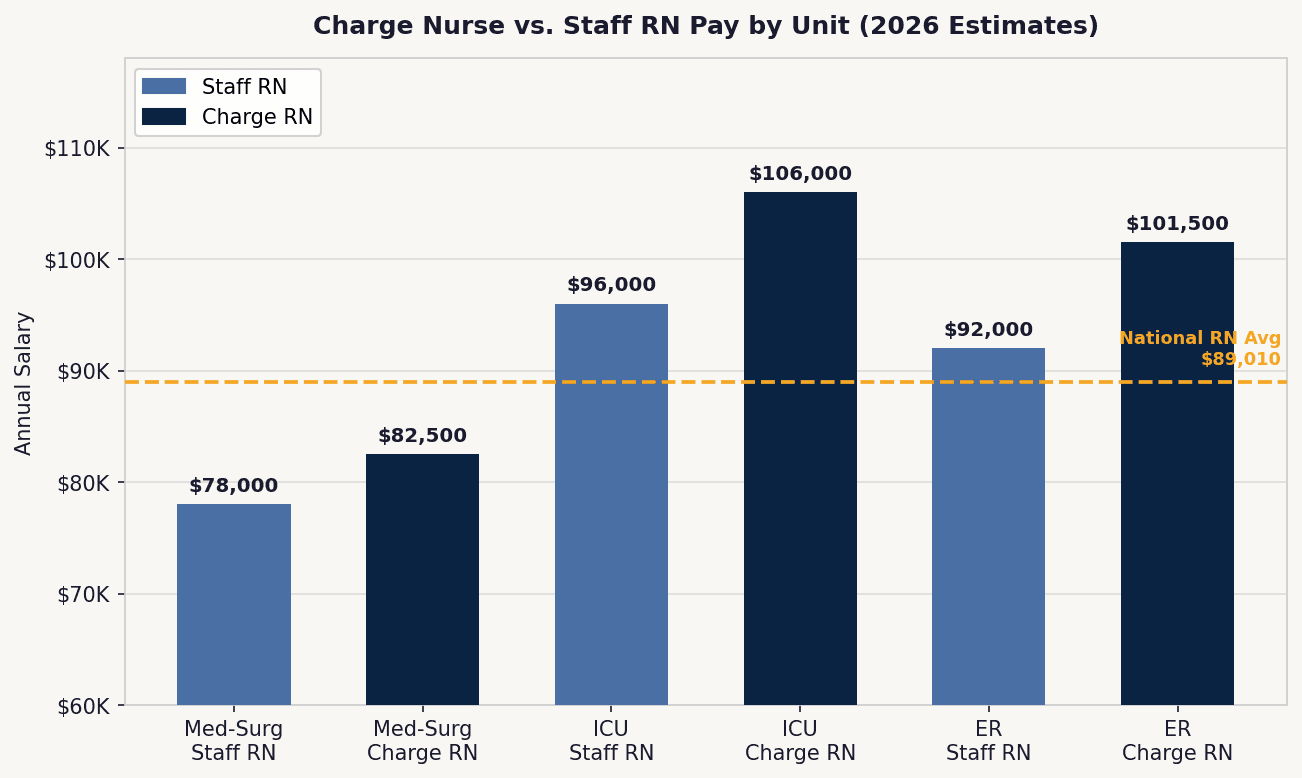
ICU and ER charge nurses earn the highest premiums ($4–$5/hr) because the clinical decision-making load on these units is substantially higher. Med-surg and telemetry charge nurses typically sit at $2–$2.50/hr above staff pay.
Charge Nurse Differential by Hospital Type
The charge nurse differential averages $3/hour nationally, but ranges from $1/hr at small LTC facilities to $6/hr at union hospitals in California and New York. On a 36-hour schedule, that difference is $5,600 vs. $11,200/year.
Charge Nurse Pay Differential by Facility Type
| Facility Type | Typical Differential | Approx. Annual Add-On |
|---|---|---|
| Major Academic / Magnet Hospital | $4–$5/hr | ~$8,000–$10,000/yr |
| Community Hospital (300+ beds) | $2.50–$4/hr | ~$5,000–$7,500/yr |
| Small Community Hospital (<200 beds) | $1.50–$2.50/hr | ~$3,000–$5,000/yr |
| Long-Term Care / SNF | $1–$2/hr (or flat per-shift) | ~$2,000–$4,000/yr |
| Unionized Hospitals (CA, NY, WA) | $3–$6/hr | ~$6,000–$12,000/yr |
Source: NurseSalaryIntel 2026 survey data

Average Charge Nurse Salary by State (2026)
State-level averages reflect both base staff RN pay and the typical charge differential for that labor market. California's lead is driven by both the highest base RN wages and the strongest union-negotiated differentials.
Charge Nurse Salary by State
| State | Avg Annual Salary | Avg Hourly Rate |
|---|---|---|
| California | $108,000 | $51.92/hr |
| New York | $93,000 | $44.71/hr |
| Washington | $91,000 | $43.75/hr |
| Massachusetts | $90,000 | $43.27/hr |
| Oregon | $88,000 | $42.31/hr |
| Colorado | $84,000 | $40.38/hr |
| National Average | $82,750 | $39.78/hr |
| Texas | $74,000 | $35.58/hr |
| Florida | $71,000 | $34.13/hr |
| Alabama | $67,000 | $32.21/hr |
Source: NurseSalaryIntel 2026 data + BLS OEWS 2025
Is Being a Charge Nurse Worth the Extra Pay?
The honest answer depends on your facility and your career goals. At well-staffed Magnet hospitals, the $4–$5/hr premium plus the leadership experience genuinely accelerates your path to manager, director, or CNO roles. At chronically understaffed facilities where charge nurses also carry full patient loads, the $1.50–$2/hr bump rarely compensates for the added stress and legal liability.
Key questions to ask before accepting a charge role: Do I still carry patients while in charge? What is the exact differential, in writing? Is the differential paid for all charge hours or only when I have zero patients? What happens when charge coverage falls through — am I expected to cover?
How to Negotiate a Higher Charge Differential
Charge differentials are often negotiable, particularly when a unit is struggling to fill the role. Approach the conversation at offer stage — once you accept, it's harder to revisit. Bring data: what do comparable hospitals in your area pay? A $1/hr increase on a 36-hour schedule is worth $1,872/year, and most nurse managers have some budget flexibility.
For unionized nurses, differential rates are set in contract and not individually negotiable — but base pay can still be moved, which increases your differential earnings automatically if differential is calculated as a percentage rather than a flat rate.
Full salary negotiation guide for nurses →Related Salary Guides
Night Shift Nurse Salary 2026
How much more nights pay vs. days
ICU Nurse Salary 2026
Highest-paying unit for charge nurses
Highest-Paying Specialties
CRNA, NP, ICU, ER rankings
Nursing Salary by Specialty
Full 18-specialty breakdown
Charge Nurse Salary by State — All 50 States
Click any state for charge nurse pay by experience, unit type, and local hospital data.
📊 Data Methodology
Salary figures on this page are 2026 estimates derived from the most recent available U.S. Bureau of Labor Statistics Occupational Employment and Wage Statistics (OEWS) data, based on the May 2024 survey and published in March 2025. Estimated ranges may also incorporate publicly available 2025 job postings, hospital pay schedules, regional market conditions, and reported compensation trends.
Official 2026 OEWS wage data has not yet been released. All salary figures on this page should be treated as informational estimates rather than official government statistics or guaranteed compensation rates.
Frequently Asked Questions
How much more does a charge nurse make than a staff RN?
How much do charge nurses make an hour?
What is the charge nurse pay differential?
Is being a charge nurse worth the extra pay?
Do charge nurses get overtime?
Can a charge nurse negotiate a higher differential?
Browse Charge Nurse Salary by State
Charge Nurse pay varies significantly by state. Select a state to see local salary data, top employers, and how it compares to the national average.
See all states: RN salary by state → · All specialties →
Download your free nursing contract audit kit — scripts, checklists, and counter-offer language
- ✓ Word-for-word counter-offer emails for each red flag clause
- ✓ Scripts for negotiating with recruiters by phone
- ✓ Legal addendum language to modify bad clauses
- ✓ What to say if they push back or say "it's standard"
Instant access · Free · No credit card