Last Updated: May 2026
Flight Nurse Salary 2026: What Air Medical RNs Really Take Home

Quick Answer
Flight nurses earn $82,000–$110,000/year in total compensation in 2026. Base salaries run $75,000–$90,000, with flight differentials, hazard pay, and overtime adding $10,000–$25,000 more. Hospital-based programs at major trauma centers are the top payers — often reaching $115,000+ in total comp.
Flight nursing sits at the top of the clinical intensity spectrum. Air medical RNs manage critical patients in confined spaces, often without physician backup, in environments where every decision is final. The compensation reflects that responsibility — and the 3–5 years of ICU or ED experience most programs require before they'll consider you.
Flight Nurse Pay Breakdown (2026)
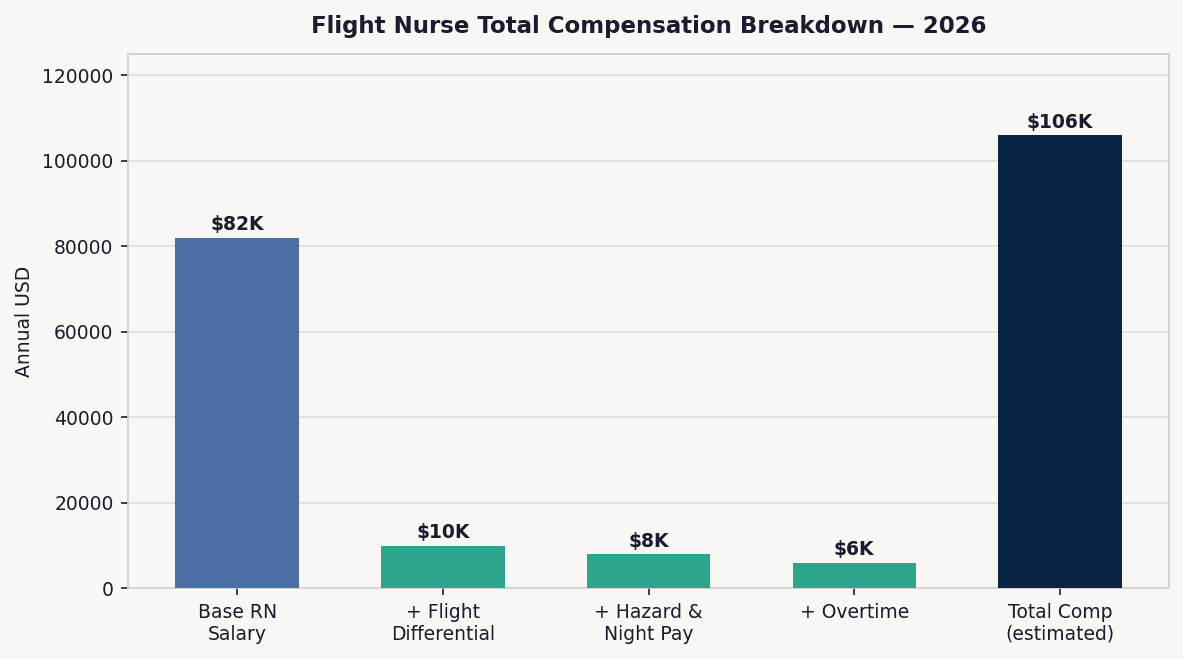
Flight nurse compensation is almost never just a base salary. Flight differentials, night and hazard premiums, and overtime are standard components — and the combination often adds $15,000–$25,000 to what looks like a modest base. The table below models a typical air medical RN compensation package.
Flight Nurse Total Compensation Breakdown
| Compensation Component | Annual Value | Rate / Structure |
|---|---|---|
| Base RN Salary | $82,000 | $39.42/hr |
| + Flight Differential Pay | $10,000 | $2–$6/hr additional |
| + Night / Hazard Differentials | $8,000 | Varies by schedule |
| + Overtime (common in air medical) | $6,000 | 1.5x base for OT hrs |
| Estimated Total Compensation | $106,000 | $50.96/hr effective |
Source: AAMS Air Medical Salary Survey 2024 + NurseSalaryIntel analysis
Flight Nurse Salary by Program Type
Hospital-based programs at major trauma centers consistently pay more than independent air medical operators — primarily because they offer full hospital benefits (pension, health insurance, PTO, education reimbursement) that independent operators often do not. The delta in total compensation between a hospital-based and contract air medical position can be $15,000–$25,000/year when benefits are included.
Flight Nurse Pay by Program Type
| Program Type | Total Annual Compensation | Notes |
|---|---|---|
| Hospital-Based (major trauma center) | $95,000–$115,000 | Strongest benefits + pay |
| Hospital-Based (community hospital) | $85,000–$100,000 | Good benefits, moderate pay |
| Air Medical Operator (national company) | $80,000–$98,000 | Wide geographic variation |
| Military / Government (USAF, Army) | $72,000–$95,000 | + full military benefits |
| Critical Care Transport (CCT, ground) | $75,000–$90,000 | Entry point into flight |
Source: AAMS Air Medical Salary Survey 2024 + NurseSalaryIntel job posting analysis

What You Need to Become a Flight Nurse
Flight nursing is not an entry-level specialty. The experience and certification bar is high — deliberately so. Patients transported by air are among the most critical in any healthcare system, and programs cannot afford to train clinicians who haven't already proven themselves under pressure.
Flight Nurse Requirements
| Requirement | Standard | Notes |
|---|---|---|
| Clinical Experience Required | 3–5 years minimum | ICU or ED preferred |
| Primary Certification | CCRN or CEN | Required at most programs |
| Flight Certification (gold standard) | CFRN (BCEN) | Earn within 12–18 mo of hire |
| Required Certs | ACLS, PALS, NRP | All current at time of hire |
| Physical Requirements | Weight limit: 250 lbs | Most rotor-wing programs |
Source: AAMS, BCEN, and program-specific hiring standards
Flight Nurse vs. ICU Nurse: Is the Pay Worth the Switch?
For an experienced ICU nurse in a major metro, the base salary difference between flight nursing and a senior hospital ICU position is often modest — sometimes $5,000–$15,000/year in total comp. The real value propositions of flight nursing are clinical autonomy (you are often the highest-level provider on scene), scope variety (trauma, stroke, STEMI, pediatrics — all on the same shift), and the lifestyle appeal of a non-traditional work environment.
The tradeoffs are real: irregular schedules, on-call requirements, weather-related delays, physical weight and fitness requirements, and the emotional weight of high-acuity mortality. Most flight nurses report that they did not take the role for pay — but that the compensation is fair for what the job demands.
CFRN Certification and Its Impact on Pay
The Certified Flight Registered Nurse (CFRN) credential from the Board of Certification for Emergency Nursing (BCEN) is the standard for flight nurse practice. Most programs won't hire uncertified candidates, or require CFRN completion within 12–18 months of hire. Certification adds an estimated $2,000–$5,000/year in pay at most programs and is required for senior flight nurse and clinical lead positions.
Related Salary Guides
Critical Care Nurse Salary 2026
ICU pay — the path to flight nursing
ICU Nurse Salary 2026
Detailed ICU RN compensation
Travel Nurse Agencies 2026
Alternative high-pay RN paths
Highest Paying Nursing Specialties
Full specialty salary comparison
📊 Data Methodology
Salary figures on this page are 2026 estimates derived from the most recent available U.S. Bureau of Labor Statistics Occupational Employment and Wage Statistics (OEWS) data, based on the May 2024 survey and published in March 2025. Estimated ranges may also incorporate publicly available 2025 job postings, hospital pay schedules, regional market conditions, and reported compensation trends.
Official 2026 OEWS wage data has not yet been released. All salary figures on this page should be treated as informational estimates rather than official government statistics or guaranteed compensation rates.
Frequently Asked Questions
How much do flight nurses make in 2026?
How much does a flight nurse make per hour?
What do you need to become a flight nurse?
Is flight nursing worth the pay cut from ICU?
What is the CFRN certification?
Do flight nurses work in helicopters and planes?
Download your free nursing contract audit kit — scripts, checklists, and counter-offer language
- ✓ Word-for-word counter-offer emails for each red flag clause
- ✓ Scripts for negotiating with recruiters by phone
- ✓ Legal addendum language to modify bad clauses
- ✓ What to say if they push back or say "it's standard"
Instant access · Free · No credit card