Last Updated: May 2026
Best Travel Nurse Agencies 2026: Pay Comparison, Contract Terms & How to Negotiate
Quick Answer: Travel nurses earn $2,600–$5,200/week all-in depending on specialty, location, and agency. No single agency consistently pays the most — the highest packages come from submitting to 3–4 agencies simultaneously and comparing packages for the same contract. FlexCare and Atlas MedStaff lead on pay transparency; Aya and AMN lead on contract volume. ICU nurses in California command the highest packages nationally at $4,000–$5,200/week.

Travel nursing has settled considerably since the pandemic-era pay peak. The $10,000/week rates of 2021–2022 are gone, but 2026 travel nurse pay remains substantially above pre-pandemic levels — and well above staff nurse rates in most markets. A California ICU traveler clearing $4,200–$5,000/week earns $175,000–$200,000+ annualized, tax-free stipends included.
The agency you work with matters — but not in the way most nurses assume. The question isn't "which agency is best?" It's "which agency is offering the best package for this specific contract at this specific facility?" Those answers change weekly. The travel nurses who earn the most treat agencies as distribution channels, not partners — submitting their profile to multiple agencies simultaneously and letting competition drive the best offer to the top.
Top Travel Nurse Agencies Ranked (2026)
Rankings based on nurse-reported pay packages, Glassdoor/Indeed reviews, pay transparency practices, and contract volume in specialty markets. Five stars = recommended without reservation; three stars = decent for specific use cases.
Travel nurse agency comparison 2026. Ratings based on nurse reviews and pay transparency.
| Agency | Rating | Summary |
|---|---|---|
| Aya Healthcare | ★★★★☆ | Largest agency by volume. Broad contract access. Pay competitive, not top. Excellent app/tech platform. |
| AMN Healthcare | ★★★☆☆ | Largest national staffing company. More system contracts. Lower pay transparency. Good benefits. |
| FlexCare Medical Staffing | ★★★★★ | Boutique, high pay transparency. "G.O. (Gold Option)" program shows full package breakdown. Consistently top-3 on pay. |
| Atlas MedStaff | ★★★★★ | Employee-owned, strong nurse loyalty. Known for high packages and honest recruiters. |
| Nomad Health | ★★★★☆ | Tech-forward, self-service. Shows package breakdown upfront. Competes well on ICU/OR specialty contracts. |
| Travel Nurse Across America (TNAA) | ★★★★☆ | Mid-size. Strong in South/Midwest. Nurse reviews consistently positive on recruiter quality. |
| Host Healthcare | ★★★★☆ | Strong West Coast/California inventory. Good package transparency. Day-one benefits. |
| Stability Healthcare | ★★★★☆ | Tech-transparent pay model. Shows blended rate vs. stipend breakdown. Strong CA contracts. |
| TotalMed | ★★★☆☆ | Broad geography, mid-tier pay. Good for nurses who want high placement volume. |
| Medical Solutions | ★★★☆☆ | Large mid-tier. Strong rural/underserved placements. Standard packages. |
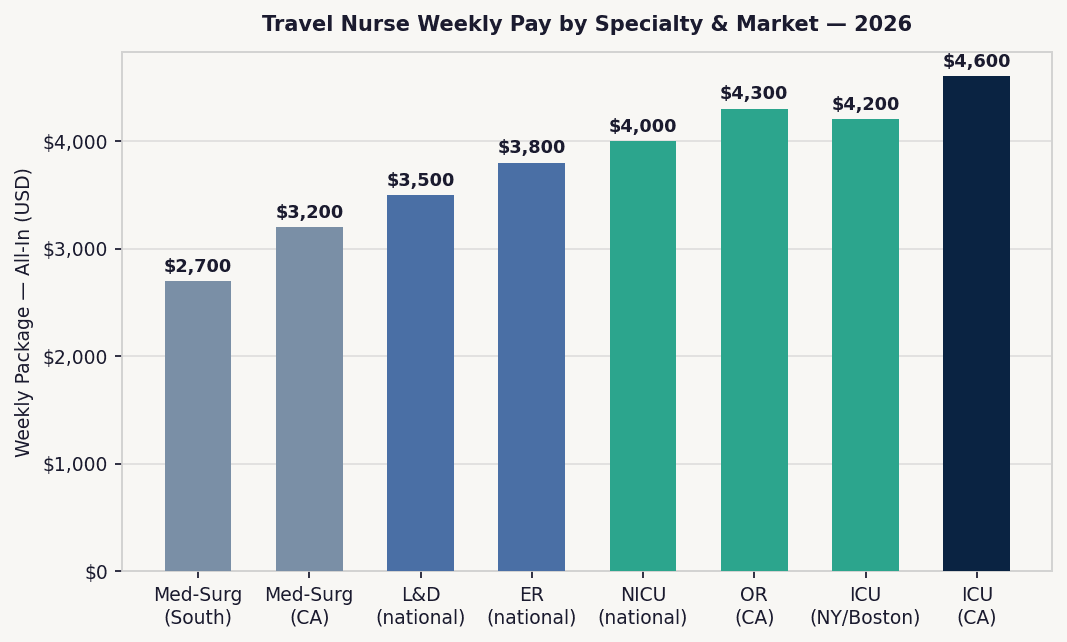
Travel Nurse Pay by Specialty and Market (2026)
Bill rates — what the hospital pays the agency — vary enormously by specialty, state, and time of year. The agency's margin (typically 20–35% of the bill rate) is why comparing packages across agencies for the same contract is so valuable. Here's the current market by specialty:
Travel nurse weekly pay by specialty and market, 2026. All-in includes taxable base + tax-free housing + meal stipends.
| Specialty + Market | Weekly Package (All-In) | Notes |
|---|---|---|
| ICU / Critical Care (California) | $4,000–$5,200/week | Highest-paying specialty + market combo |
| OR (California) | $3,800–$4,800/week | Robotic proficiency adds $200–$500/week |
| ICU (New York / Boston) | $3,800–$4,600/week | Competitive with CA on top contracts |
| L&D (California) | $3,600–$4,400/week | High-risk MFM at top of range |
| NICU (national) | $3,400–$4,600/week | Level IV facilities pay premium |
| ER / ED (national) | $3,200–$4,400/week | Level I trauma premium |
| Med-Surg / PCU (California) | $2,800–$3,600/week | Ratio law keeps CA floor high |
| Med-Surg (South / Midwest) | $2,400–$3,000/week | Lowest-paying market / specialty combo |
California consistently tops the range because: (1) mandatory nurse-to-patient ratios limit the hospital's ability to run short-staffed as an alternative to agency, (2) cost of living drives housing stipend amounts up, and (3) the state's labor market competitiveness keeps bill rates elevated. For travelers willing to build consecutive California contracts across different facilities (to maintain tax-home compliance), the earning potential is unmatched.

How to Negotiate the Best Travel Nurse Package
Most travel nurses accept the first offer from their recruiter. The nurses who maximize their earnings treat every contract as a negotiation. Here's the leverage you have:
Travel nurse contract negotiation tactics and their pay impact.
| Tactic | Impact Level | How to Use It |
|---|---|---|
| Submit to 3–4 agencies simultaneously | High impact | Creates competition — agencies may match or beat each other |
| Request blended rate / pay breakdown | High impact | Agencies that won't show breakdown are hiding unfavorable splits |
| Negotiate guaranteed hours (36/week) | Critical | Without this, you can be sent home unpaid on slow days |
| Ask about referral bonuses | Medium impact | $500–$2,000 per referred nurse who completes a contract |
| Time extensions for same facility | Medium impact | Often higher pay than initial contract — facilities pay for proven performers |
| Request completion bonus in writing | Medium impact | $500–$2,000 common on hard-to-fill contracts |
Understanding Your Pay Package: The Blended Rate Breakdown
Every travel nurse package is built from the same components. Understanding them protects you from low-base tricks that reduce your overtime earnings:
- Taxable base wage ($22–$30/hr): This is what's used to calculate overtime. Agencies sometimes quote a high all-in rate while keeping the base low — which means overtime is calculated at 1.5× a small number rather than 1.5× your true effective rate. Always ask: "What is my base wage for overtime calculation?"
- Tax-free housing stipend ($900–$1,800/week): Only valid if you maintain a qualifying tax home. Paid weekly regardless of hours, not included in overtime calculation. The geographic component — GSA per diem rates set the IRS maximum for each city.
- Tax-free meals/incidentals stipend ($280–$500/week): Also tied to GSA rates. Paid as a daily rate across your contract weeks, not per shift.
- Agency-provided housing vs. stipend: Always choose the stipend over agency-provided housing. Agency housing is often shared, distant from the facility, or lower quality than what you'd choose. The stipend gives you control and usually nets you more flexibility.
Tax Home Rules: The #1 Travel Nurse Financial Mistake
The IRS requires that you be "away from home" to receive non-taxable travel benefits. If you don't have a qualifying tax home — a permanent place of business where you bear duplicated expenses — then ALL of your housing and meal stipends are legally taxable income.
For nurses who sold their permanent residence and became "nomadic," the IRS considers wherever they work to be their tax home, eliminating stipend tax-free status. The cost of maintaining a tax home (rent, utilities — typically $600–$1,000/month) is almost always worth it: at a $1,400/week combined stipend, having that stipend be tax-free saves approximately $19,000–$26,000/year in federal and state income taxes versus having it taxed at your marginal rate.
Consult a tax professional familiar with travel nursing before your first contract. The RV and nomadic nurse communities have built significant expertise here — look for CPAs who specialize in travel healthcare workers.
Specialty Pay — Which Units Travel Best?
Not all nurses can travel in every specialty. Most facilities require demonstrable recent experience in the specific unit type — typically 2+ years. Here's how the specialties rank by travel market desirability and earnings:
- ICU (best overall): Highest demand, highest pay, broadest geography. CCRN certification materially improves placement rate in premium contracts.
- OR (high demand, specialized): High pay but harder to place — facilities require specialty service experience (cardiac, ortho, robotics). The pool of qualified OR travelers is small, which keeps rates high.
- L&D (stable, year-round): Birth volume doesn't vary seasonally like flu/respiratory. Consistent demand. RNC-OB and C-EFM required or preferred at most facilities.
- ER/ED (high demand, volatile): Rates are high but contract cancellations are more common — ED census is unpredictable and facilities sometimes cancel when volume drops.
- NICU (specialty premium): Level IV NICU experience is rare. Nurses who can demonstrate NICU-specific skills command premium placement.
- Med-Surg/PCU (easiest entry, lowest pay): Easiest to enter travel nursing, but also the most price-competitive specialty. Good for building initial travel experience before transitioning to higher-acuity travel roles.
Staff vs. Travel: The Long-Run Math
Travel nursing earns more on a per-week basis, but the comparison isn't straightforward over a career. Consider:
- Retirement contributions: Many travel agencies offer 401(k) matches, but the benefit is typically less generous than a Magnet hospital's 403(b) with pension top-up. A nurse who stays staff at Kaiser for 20 years accumulates a defined benefit pension that travel nursing can't replicate.
- Step scale earnings: A CNA-contract Kaiser nurse reaches $140,000–$148,000 after 15 years through guaranteed step increases. That's competitive with, and in some scenarios exceeds, what an average traveler earns once you normalize for gaps between contracts and the cost of maintaining a tax home.
- The hybrid strategy: Many nurses do 3–5 years of travel to pay off loans or build capital, then return to staff nursing to lock in union step scale benefits for the last 15–20 years of their career. That combined arc often outperforms either pure strategy alone.
Use our nurse salary calculator to model your specific numbers — staff vs. travel, by specialty and state.
Sources & Methodology: Agency ratings based on aggregate nurse reviews from Glassdoor, Indeed, Travel Nursing Central, and The Gypsy Nurse community surveys (2024–2025). Pay package ranges based on recruiter-reported rates and NurseFly/Vivian marketplace data for Q1 2026. Tax home guidance based on IRS Publication 463 (Travel, Gift, and Car Expenses). Individual contract rates vary by facility, specialty, and timing. This page does not constitute tax or legal advice.
Related Salary Guides
📊 Data Methodology
Salary figures on this page are 2026 estimates derived from the most recent available U.S. Bureau of Labor Statistics Occupational Employment and Wage Statistics (OEWS) data, based on the May 2024 survey and published in March 2025. Estimated ranges may also incorporate publicly available 2025 job postings, hospital pay schedules, regional market conditions, and reported compensation trends.
Official 2026 OEWS wage data has not yet been released. All salary figures on this page should be treated as informational estimates rather than official government statistics or guaranteed compensation rates.
Frequently Asked Questions
Which travel nurse agency pays the most in 2026?
What is a typical travel nurse pay package in 2026?
What is a tax home and why does it matter for travel nurses?
What should I look for in a travel nurse contract?
Download your free nursing contract audit kit — scripts, checklists, and counter-offer language
- ✓ Word-for-word counter-offer emails for each red flag clause
- ✓ Scripts for negotiating with recruiters by phone
- ✓ Legal addendum language to modify bad clauses
- ✓ What to say if they push back or say "it's standard"
Instant access · Free · No credit card