Last Updated: May 2026
Certified Nurse Midwife Salary 2026: What CNMs Really Earn

Quick Answer
Certified nurse midwives earn $120,880/year ($58.11/hr) based on the latest BLS data nationally — roughly $35,000/year more than L&D RNs with the same clinical setting. California CNMs lead all states at $148,000/year. CNMs with full practice authority and independent birth centers can earn $145,000+.
The certified nurse midwife credential sits at the intersection of advanced practice nursing and obstetric care. CNMs manage prenatal visits, labor, delivery, and postpartum care — and in 37 states plus DC, they do it independently without physician oversight. That scope of practice is reflected directly in their pay.
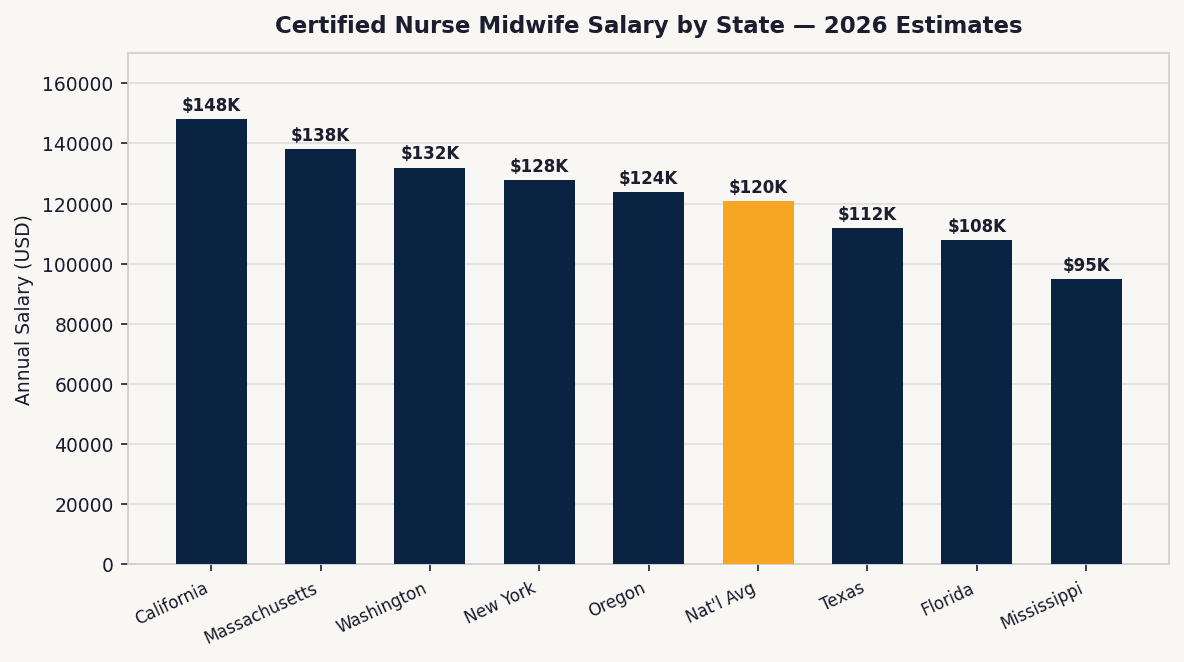
CNM Salary by State (2026)
California and Massachusetts dominate the top of the CNM salary rankings, driven by union contracts, high hospital density, and cost-of-living adjustments. The gap between the highest-paying state (California, $148,000) and lowest (Mississippi, $95,000) is $53,000/year — among the widest spreads of any advanced practice nursing specialty.
Certified Nurse Midwife Salary by State
| State | Avg Annual Salary | Avg Hourly Rate |
|---|---|---|
| California | $148,000 | $71.15/hr |
| Massachusetts | $138,000 | $66.35/hr |
| Washington | $132,000 | $63.46/hr |
| New York | $128,000 | $61.54/hr |
| Oregon | $124,000 | $59.62/hr |
| National Average | $120,880 | $58.11/hr |
| Texas | $112,000 | $53.85/hr |
| Florida | $108,000 | $51.92/hr |
| Mississippi | $95,000 | $45.67/hr |
Source: BLS OEWS May 2024 (published 2025) + 2026 estimates
CNM Salary by Work Setting
Where a CNM practices matters almost as much as which state they work in. Independent birth center owners and hospital CNMs at Level III/IV trauma centers consistently out-earn their peers in community hospitals and federally qualified health centers — though FQHCs often offer loan repayment programs worth $50,000+ that close the gap considerably.
CNM Pay by Work Setting (2026)
| Work Setting | Avg Annual Salary | Avg Hourly Rate |
|---|---|---|
| Independent Birth Center (owner) | $145,000+ | Variable |
| Hospital — Level III/IV NICU | $132,000 | $63.46/hr |
| Private OB/GYN Group Practice | $128,000 | $61.54/hr |
| Hospital — Community (Level I/II) | $122,000 | $58.65/hr |
| Federally Qualified Health Center (FQHC) | $118,000 | $56.73/hr |
| Telehealth / Remote Prenatal | $105,000 | $50.48/hr |
Source: BLS OEWS May 2024 + AMCB workforce data

CNM vs. L&D RN vs. OB/GYN NP: The Full Comparison
For L&D nurses considering the CNM path, the salary math is compelling: the $35,000/year premium over a BSN-prepared L&D RN typically recoups MSN program costs (average $30,000–$50,000) within two years of graduation. CNMs who go on to complete a DNP unlock additional administrative, faculty, and independent practice opportunities.
Maternal & Women's Health Career Salary Comparison
| Credential | Avg Annual Salary | Premium & Notes |
|---|---|---|
| L&D RN (BSN) | $86,000/yr | $41.35/hr |
| CNM (MSN) | $120,880/yr | $58.11/hr — +$35K vs L&D RN |
| WHNP (Women's Health NP) | $122,000/yr | $58.65/hr |
| OB/GYN NP (hospital) | $118,000/yr | $56.73/hr |
| Neonatal NP (ACNP) | $126,000/yr | $60.58/hr |
Source: BLS OEWS May 2024 + NurseSalaryIntel 2026 estimates
Full Practice Authority and CNM Pay
State practice authority laws directly shape what CNMs can earn. In full-authority states — California, Oregon, Washington, Colorado, Minnesota, and 33 others — CNMs can open independent practices, bill insurers directly, and negotiate their own compensation. In restricted states, CNMs require a collaborative agreement with an OB/GYN physician, which often means working as an employee rather than an independent provider.
The pay gap between full-authority and restricted states is measurable: CNMs in full-authority states earn an estimated 8–12% more on average, primarily because they can capture revenue streams (telehealth, group prenatal, birth center fees) unavailable to employed CNMs.
Nurse Midwife vs. Midwife: What's the Difference?
A certified nurse midwife (CNM) holds an RN license plus a master's or doctoral degree in nurse-midwifery. A certified midwife (CM) has graduate-level midwifery education but does not hold an RN license. CMs are only recognized in a handful of states. A certified professional midwife (CPM) is a credential focused on out-of-hospital birth and is not recognized by Medicare or most hospital credentialing bodies. For career earnings and portability, the CNM credential is by far the strongest.
Negotiating Your CNM Offer
CNMs have more leverage than most nurses when negotiating because midwifery-trained providers are in genuine short supply — the ACNM projects a significant workforce gap through 2030. Key items to negotiate beyond base salary: call pay (typically $5–$15/hr extra), delivery bonuses ($50–$200 per attended birth), malpractice tail coverage (worth $10,000–$30,000 when changing jobs), and loan repayment if joining an FQHC or rural health clinic.
Related Salary Guides
L&D Nurse Salary 2026
The RN path in maternal care
Women's Health NP Salary 2026
WHNP vs CNM pay comparison
Nurse Practitioner Salary 2026
Full NP salary breakdown
Nurse Salary Negotiation Guide
Negotiate your next CNM offer
📊 Data Methodology
Salary figures on this page are 2026 estimates derived from the most recent available U.S. Bureau of Labor Statistics Occupational Employment and Wage Statistics (OEWS) data, based on the May 2024 survey and published in March 2025. Estimated ranges may also incorporate publicly available 2025 job postings, hospital pay schedules, regional market conditions, and reported compensation trends.
Official 2026 OEWS wage data has not yet been released. All salary figures on this page should be treated as informational estimates rather than official government statistics or guaranteed compensation rates.
Frequently Asked Questions
How much does a certified nurse midwife make in 2026?
How much does a nurse midwife make per hour?
Is a nurse midwife salary higher than a labor and delivery RN?
What degree do you need to become a certified nurse midwife?
What state pays nurse midwives the most?
Can a nurse midwife have their own practice?
Download your free nursing contract audit kit — scripts, checklists, and counter-offer language
- ✓ Word-for-word counter-offer emails for each red flag clause
- ✓ Scripts for negotiating with recruiters by phone
- ✓ Legal addendum language to modify bad clauses
- ✓ What to say if they push back or say "it's standard"
Instant access · Free · No credit card