Last Updated: April 27, 2026
RN vs LPN Salary 2026: The $29,280 Pay Gap, Decoded

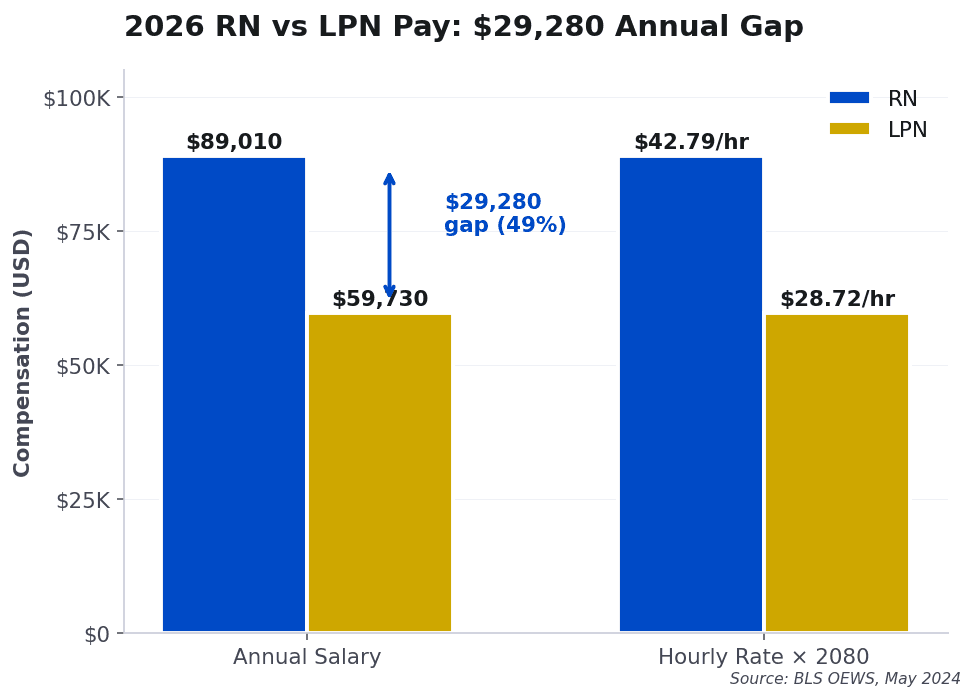
Registered Nurses (RNs) earn approximately $89,000 per year based on the latest BLS data, while Licensed Practical Nurses (LPNs) earn $59,730 — a $29,280 gap, or 49% higher pay for RNs. Hourly, that's $42.79 for RNs versus $28.72 for LPNs. The pay gap looks larger than the education gap (1–2 extra years), which is why most nurses ask the same question: is the RN path actually worth the time and tuition?
Short answer: usually yes, with the ROI breaking even by year 3 in most states. Here's the full math, including the states where the gap is widest, the LPN-to-RN bridge programs that close the gap fastest, and the situations where staying as an LPN actually makes more financial sense.
RN vs LPN at a Glance (2026)
RN vs LPN Comparison Overview (2026)
| Metric | Pay | Gap |
|---|---|---|
| Average annual salary | RN: $89,010 | LPN: $59,730 | Gap: $29,280 (49%) |
| Average hourly rate | RN: $42.79 | LPN: $28.72 | Gap: $14.07 |
| Entry-level (0–2 yrs) | RN: $68,200 | LPN: $50,400 | Gap: $17,800 |
| Senior (10+ yrs) | RN: $112,400 | LPN: $72,600 | Gap: $39,800 |
| Top 10% earners | RN: $129,400+ | LPN: $76,580+ | Gap: $52,820 |
Source: BLS OEWS, May 2024 + 2026 projection (3.1% RN / 2.9% LPN).
The gap widens with experience. A new-grad RN earns $17,800 more than a new-grad LPN; a senior RN earns $39,800 more than a senior LPN. RNs have a longer compensation runway because they're qualified for specialty units, supervisory roles, advanced certifications, and the path to NP and CRNA — which LPNs are not.
Side-by-Side Pay by Percentile
RN vs LPN by Percentile (2026)
| Percentile | RN | LPN |
|---|---|---|
| 10th percentile (entry) | RN: $63,720 | LPN: $46,090 |
| 25th percentile | RN: $74,300 | LPN: $51,890 |
| 50th percentile (median) | RN: $86,070 | LPN: $58,360 |
| 75th percentile | RN: $102,420 | LPN: $66,140 |
| 90th percentile (top) | RN: $129,400 | LPN: $76,580 |
Source: BLS OEWS percentile data, May 2024, projected to 2026.
Hourly Rate Comparison: Per Shift Math
Most RN and LPN roles are hourly W-2 — your real take-home is hourly × hours × shift differential, not the headline annual figure.
- RN base: $42.79/hr × 2,080 hours = approximately $89,000/year (full-time, no OT)
- LPN base: $28.72/hr × 2,080 hours = $59,730/year
Per shift (12 hours): RN earns $513 vs LPN $345 — a $168/shift gap. Across 13 shifts/month, that's $2,184/month or $26,200/year before differentials and overtime.
RN vs LPN Salary by State — Top 5 Widest Gaps
States with Widest 2026 RN-LPN Pay Gap
| State | Salaries | Annual Gap |
|---|---|---|
| California | RN: $138,180 | LPN: $74,560 | Gap: $63,620 |
| Hawaii | RN: $116,260 | LPN: $61,920 | Gap: $54,340 |
| Massachusetts | RN: $109,820 | LPN: $66,510 | Gap: $43,310 |
| New York | RN: $104,570 | LPN: $61,070 | Gap: $43,500 |
| Oregon | RN: $108,460 | LPN: $66,470 | Gap: $41,990 |
Source: BLS OEWS state data, May 2024.
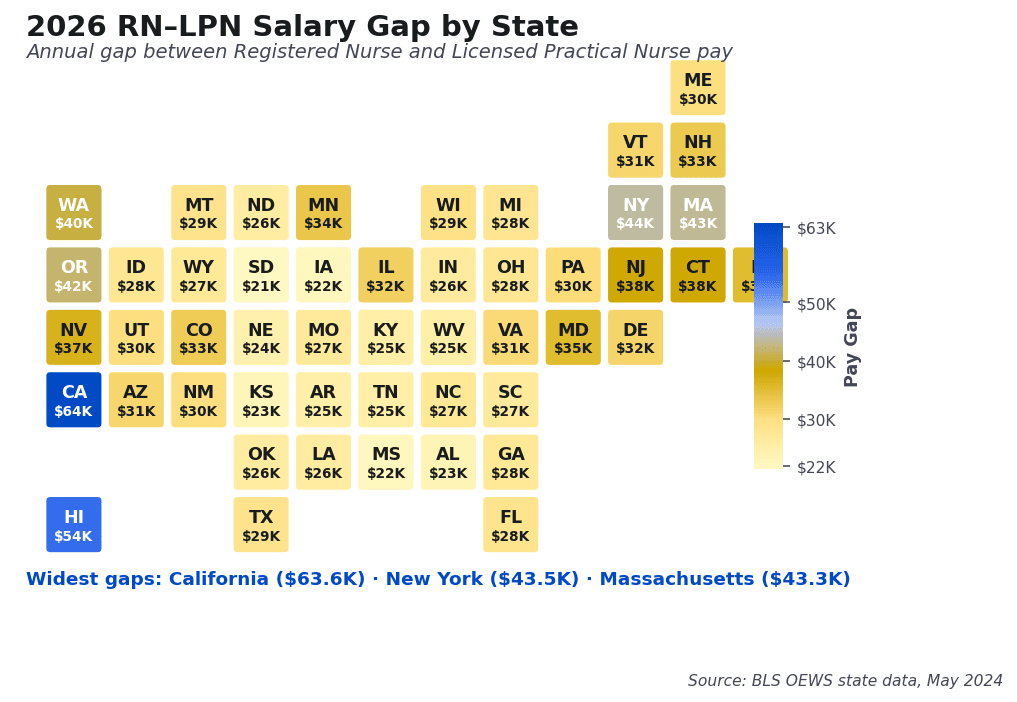
In high-pay coastal states, the LPN-to-RN ROI is dramatic — California's $63,620 annual gap pays back even an $80,000 BSN within 18 months. In lower-pay rural states, the gap is narrower (~$22,000–$26,000), and the financial case for staying as an LPN strengthens.
Education Cost & Time: ADN vs LPN vs BSN
Nursing Education Pathways (2026)
| Path | Time to Complete | Total Cost Range |
|---|---|---|
| LPN (Practical Nursing diploma) | 12–18 months | $5K – $20K |
| ADN (Associate Degree in Nursing) | 24 months | $10K – $40K |
| BSN (Bachelor of Science in Nursing) | 4 years | $40K – $120K |
| LPN-to-RN bridge | 12–18 months extra | $8K – $30K |
| LPN-to-BSN bridge | 24–36 months extra | $25K – $60K |
Source: Aggregated from 80+ accredited nursing programs nationwide, 2026 academic year.
Most cost-efficient path to RN: ADN at a community college ($12,000–$25,000 total). Many community college ADN programs in Texas, Florida, and the Midwest cost under $15,000 all-in. Hospitals have largely accepted ADN-prepared RNs (with a BSN-completion contingency clause) due to the post-pandemic nursing shortage.
5-Year and 10-Year Earnings Difference (With Math)
Assume two nurses, both starting their careers in May 2026:
Scenario A — Stay LPN. Sarah completes a 12-month LPN program ($12,000), starts working in month 13. 10-year total: ~$628,650 minus $12,000 education = $616,650 net.
Scenario B — Go RN via ADN. Mark completes a 24-month ADN program ($18,000), starts working in month 25. 10-year total earnings: ~$739,050 minus $18,000 education = $721,050 net.
Mark earns $104,400 more than Sarah over 10 years, even after losing 2 years of LPN earnings during ADN school. The break-even point comes around month 30 of post-graduation work — roughly year 4.5 from his initial enrollment.
Beyond Pay: Scope of Practice Differences
Pay reflects scope. Here's what each license can and cannot do:
RN scope:
- Independent patient assessment and care planning
- IV starts, central line care, blood transfusions
- Triage and admit/discharge decisions
- Supervise LPNs and CNAs
- Eligible for charge nurse, ICU/ER specialty units
- Eligible for advanced practice (NP, CRNA, CNS, CNM with grad school)
- Most eligible for travel nursing
LPN scope (varies by state):
- Patient care under RN/MD direction
- Medication administration (state-dependent — some states restrict IV push)
- Wound care, feeding tubes, bedside care
- Cannot independently assess unstable patients
- Limited to long-term care, clinics, home health, some skilled nursing in most states
The pay gap reflects this scope gap. RNs carry more liability and decision-making, which the market prices in. For a comparison of advancement paths, see ICU Nurse Salary and ER Nurse Salary — two specialty pay caps RNs can reach but LPNs cannot.

LPN to RN Bridge Programs (Worth It?)
LPN-to-RN bridge programs let you skip foundational nursing courses already covered in your LPN training. Most bridges are 12–18 months and add 30–40 credit hours.
Top LPN-to-RN bridge programs (2026):
- Excelsior College (online, NCLEX prep focused) — $15,000–$22,000
- Western Governors University (competency-based) — $13,500–$16,000
- Galen College of Nursing (multiple state campuses) — $18,000–$28,000
- Most state community college LPN-to-ADN bridges — $6,000–$15,000
Worth it for most LPNs. With the average RN-LPN gap at $29,280/year, a $20,000 bridge program pays itself back in 8.2 months of post-graduation work. Even in the lowest-pay states (gap ~$22,000), payback is ~11 months. See our Best RN-to-BSN Programs for next-step program comparisons.
Career Outlook: BLS Job Growth 2024–2034
- RN job growth 2024–2034: +6% (175,200 net new positions)
- LPN job growth 2024–2034: +3% (28,400 net new positions)
Both grow faster than the average for all occupations (+4%), but RN demand is structurally stronger because of an aging population, hospital-based care complexity, the advanced-practice pipeline, and the travel/per-diem premium markets being RN-dominated.
When LPN Might Make More Sense
- You need to be working in 12–18 months. If you have urgent financial obligations, LPN gets you earning fast.
- You want to test the field before committing. Many people enter nursing via LPN to confirm they like the work before investing in a 4-year BSN.
- You're targeting long-term care, hospice, or clinic work. LPN scope covers most of these settings.
- You're in a low-gap state (Alabama, South Dakota, etc.) and don't plan to relocate.
- You're using LPN as a stepping stone while completing your ADN/BSN — especially with employer tuition reimbursement.
For most career nurses with long-term horizons, however, RN remains the higher-ROI license. See our companion guide on BSN vs RN salary and Entry Level Nurse Salary 2026. If you're weighing the LVN path specifically, our LVN Salary 2026 guide breaks down pay by state and work setting.
Sources: U.S. Bureau of Labor Statistics — OEWS, Registered Nurses (29-1141) and Licensed Practical Nurses (29-2061), May 2024; BLS Employment Projections 2024–2034; American Association of Colleges of Nursing — Nursing Education Statistics 2026; National Council of State Boards of Nursing (NCSBN) — NCLEX Pass Rate Reports. Methodology: Salary figures projected to 2026 using BLS-published wage growth rates of 3.1% for RNs and 2.9% for LPNs. Education cost ranges aggregate published tuition data from 80+ accredited nursing programs across all 50 states. 10-year earnings calculations assume continuous full-time employment with average annual COL increases. Not career or financial advice.
📊 Data Methodology
Salary figures on this page are 2026 estimates derived from the most recent available U.S. Bureau of Labor Statistics Occupational Employment and Wage Statistics (OEWS) data, based on the May 2024 survey and published in March 2025. Estimated ranges may also incorporate publicly available 2025 job postings, hospital pay schedules, regional market conditions, and reported compensation trends.
Official 2026 OEWS wage data has not yet been released. All salary figures on this page should be treated as informational estimates rather than official government statistics or guaranteed compensation rates.
Frequently Asked Questions
How much more does an RN make than an LPN?
Is becoming an RN worth it over an LPN?
How long does it take to go from LPN to RN?
Can an LPN make as much as an RN?
Which is harder, NCLEX-RN or NCLEX-PN?
Do hospitals still hire LPNs?
Can an LPN become a nurse practitioner?
Are LPN salaries growing or shrinking?
Download your free nursing contract audit kit — scripts, checklists, and counter-offer language
- ✓ Word-for-word counter-offer emails for each red flag clause
- ✓ Scripts for negotiating with recruiters by phone
- ✓ Legal addendum language to modify bad clauses
- ✓ What to say if they push back or say "it's standard"
Instant access · Free · No credit card