Last Updated: April 2026
ICU vs ER Nurse Salary 2026: Which Specialty Pays More?
Quick Answer
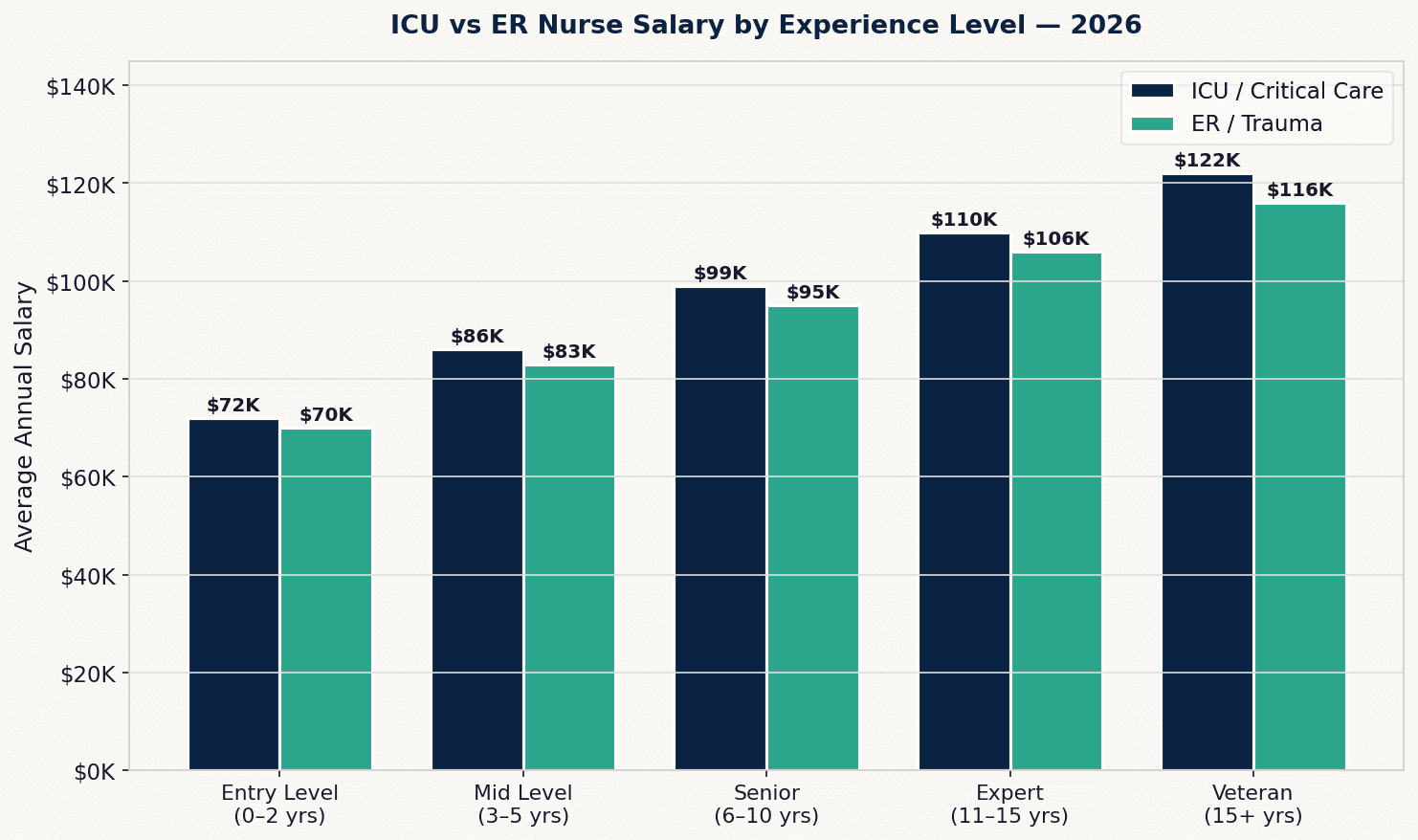
ICU nurses earn slightly more — $95,200/year vs. ER nurses at $92,800/year nationally in 2026. The $2,400 gap grows with experience: CCRN-certified ICU nurses with 8+ years average $108,000–$128,000, while CEN-certified ER nurses hit $104,000–$122,000. Both beat the RN national average by 20–25%.
ICU and ER nursing are the two most popular high-acuity specialties — and the pay difference between them is smaller than most nurses expect. The bigger distinction is in career trajectory, lifestyle, and which specialty sets you up better for your next move.

ICU vs ER Nurse Salary: Full Comparison (2026)
ICU vs ER Nurse Salary — Head-to-Head (2026)
| Category | ICU Nurse | ER Nurse |
|---|---|---|
| National Avg Salary | ICU: $95,200/yr | ER: $92,800/yr |
| Avg Hourly Rate | ICU: $45.77/hr | ER: $44.61/hr |
| Entry (0–2 yrs) | ICU: $78,400–$88,600 | ER: $74,800–$85,200 |
| Mid (3–7 yrs) | ICU: $92,000–$108,000 | ER: $88,000–$104,000 |
| Senior (8+ yrs) | ICU: $108,000–$128,000 | ER: $104,000–$122,000 |
| Top State (CA) | ICU: $124,400 | ER: $120,800 |
| Night Differential | ICU: +$12K–$20K/yr | ER: +$12K–$18K/yr |
| Cert Premium (avg) | CCRN: +$5,200/yr | CEN: +$4,400/yr |
Source: BLS OEWS 2025 + NurseSalaryIntel 2026 specialty data
Why ICU Nurses Earn Slightly More
The ICU pay premium comes from two factors. First, ICU nurses typically manage fewer patients (1:2 ratio vs. ER's variable 1:4–1:8), which commands higher hourly rates at facilities that staff by acuity. Second, the CCRN certification is more universally required for charge and lead ICU roles, creating a clearer pay step than ER certification pathways.
That said, Level 1 trauma center ERs close the gap considerably. A trauma-certified ER nurse at a Level 1 center in California can earn $118,000–$130,000 — comparable to ICU counterparts in the same facility.
Sign-On Bonuses: ICU vs ER (2026)
Sign-On Bonuses — ICU vs ER Nurses (2026)
| Role | Typical Sign-On Range | Commitment |
|---|---|---|
| Entry-Level ICU | $8,000–$15,000 | 18–24 month commitment |
| Experienced ICU (3+ yrs) | $15,000–$25,000 | 2-year commitment typical |
| CVICU / SICU / Trauma ICU | $18,000–$30,000 | Highest demand specialty |
| Entry-Level ER | $6,000–$12,000 | 12–18 month commitment |
| Experienced ER (3+ yrs) | $12,000–$20,000 | 2-year commitment typical |
| Level 1 Trauma ER | $15,000–$22,000 | Trauma cert adds premium |
Source: NurseSalaryIntel hospital survey data, 2026
ICU sign-ons run higher overall, particularly for subspecialties. CVICU and SICU positions at major academic medical centers routinely offer $20,000–$30,000 for experienced nurses. ER sign-ons are competitive but slightly lower, reflecting the broader applicant pool and faster training curve.
Certifications That Increase Pay
- CCRN (ICU): Adds $4,000–$7,000/year. Required for charge roles at most ICUs. The gold standard for critical care nurses.
- CEN (ER): Adds $3,500–$5,500/year. Widely respected but not universally mandated — gives an edge in competitive markets.
- TNCC (Trauma Nursing Core Course): Required at most Level 1 trauma ERs. Usually employer-paid; adds $2,000–$4,000/year at trauma centers.
- CFRN (Flight): For ER nurses pursuing flight nursing — adds $6,000–$12,000/year above base ER pay.
Career Trajectory: Which Specialty Opens More Doors?
ICU nursing has a clearer path to the highest-paying nursing credential: CRNA. Most CRNA programs require 1–2 years of ICU experience, making ICU the deliberate on-ramp for nurses targeting $180,000–$250,000 anesthesia salaries. See the CRNA salary guide for the full ROI breakdown.
ER nursing builds broader clinical competency — airway management, cardiovascular emergencies, pediatric emergencies, psychiatric crises — that translates well to flight nursing, emergency nurse practitioner (ENP) programs, and leadership roles in fast-paced environments.

Which Should You Choose?
- Choose ICU if: You want the highest long-term ceiling, are considering CRNA, prefer lower patient ratios and deeper clinical relationships, and can handle the emotional weight of critical illness.
- Choose ER if: You thrive in fast, unpredictable environments, want broad clinical exposure, prefer the autonomy of triage decisions, and are drawn to flight nursing or emergency NP roles.
- Either works for travel nursing: Both command $48–$78/hr on travel contracts. ICU slightly edges ER for per-diem and travel rates due to sustained critical care demand.
Related Salary Guides
ICU Nurse Salary (Full Guide)
CCRN premium, state breakdown, CRNA path
ER Nurse Salary (Full Guide)
CEN premium, Level 1 trauma pay
CRNA Salary 2026
$214K avg — the ICU-to-CRNA path
Travel vs Staff Nurse Salary
Which earns more total in 2026?
Sources
- BLS OEWS — Registered Nurses, National and State Data
- American Association of Colleges of Nursing (AACN)
- Emergency Nurses Association (ENA)
📊 Data Methodology
Salary figures on this page are 2026 estimates derived from the most recent available U.S. Bureau of Labor Statistics Occupational Employment and Wage Statistics (OEWS) data, based on the May 2024 survey and published in March 2025. Estimated ranges may also incorporate publicly available 2025 job postings, hospital pay schedules, regional market conditions, and reported compensation trends.
Official 2026 OEWS wage data has not yet been released. All salary figures on this page should be treated as informational estimates rather than official government statistics or guaranteed compensation rates.
Frequently Asked Questions
Do ICU nurses make more than ER nurses?
What certifications increase pay most for ICU vs ER nurses?
Is ICU or ER nursing better for career advancement?
Which specialty is harder to get hired into — ICU or ER?
How do night shift differentials compare for ICU vs ER nurses?
Download your free nursing contract audit kit — scripts, checklists, and counter-offer language
- ✓ Word-for-word counter-offer emails for each red flag clause
- ✓ Scripts for negotiating with recruiters by phone
- ✓ Legal addendum language to modify bad clauses
- ✓ What to say if they push back or say "it's standard"
Instant access · Free · No credit card