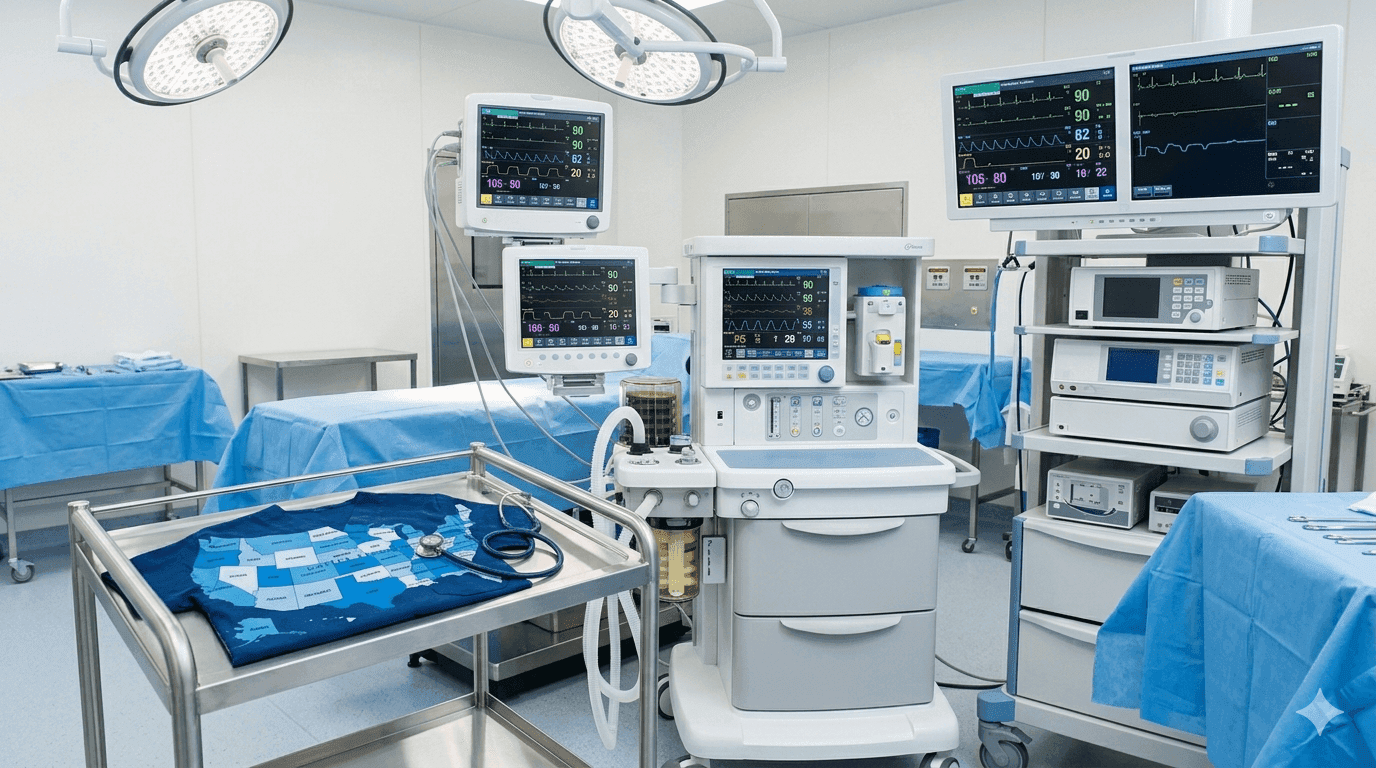
CRNA is the highest-paid nursing role in the country — and it isn't close. The average Certified Registered Nurse Anesthetist cleared $232,000 in 2026, with top states pushing past $300,000. But where you practice matters enormously: the spread between the highest- and lowest-paying states is more than $100,000 per year for the same credential and scope.
Last updated: April 2026. Salary figures blend BLS OEWS data, Medscape compensation reports, and verified offers from CRNAs practicing in each state.
Average CRNA Salary by State (2026)
| Rank | State | Avg CRNA Salary | Scope / Supervision |
|---|---|---|---|
| 1 | Illinois | $312,000 | Opt-out state |
| 2 | Wyoming | $305,000 | Opt-out state |
| 3 | Vermont | $298,000 | Opt-out state |
| 4 | Connecticut | $288,000 | Supervision |
| 5 | Montana | $285,000 | Opt-out state |
| 6 | California | $282,000 | Opt-out state |
| 7 | New Jersey | $275,000 | Supervision |
| 8 | Oregon | $272,000 | Supervision |
| 9 | Washington | $268,000 | Supervision |
| 10 | Massachusetts | $265,000 | Supervision |
| 11 | New York | $260,000 | Supervision |
| 12 | Minnesota | $258,000 | Opt-out state |
| 13 | Wisconsin | $252,000 | Opt-out state |
| 14 | Iowa | $248,000 | Opt-out state |
| 15 | Nevada | $245,000 | Supervision |
| 16 | Michigan | $240,000 | Supervision |
| 17 | Colorado | $238,000 | Opt-out state |
| 18 | Pennsylvania | $232,000 | Supervision |
| 19 | Maine | $228,000 | Supervision |
| 20 | Texas | $225,000 | Supervision |
| 21 | Arizona | $220,000 | Supervision |
| 22 | Virginia | $218,000 | Supervision |
| 23 | Maryland | $215,000 | Supervision |
| 24 | North Carolina | $212,000 | Supervision |
| 25 | Ohio | $210,000 | Supervision |
| 26 | New Mexico | $208,000 | Opt-out state |
| 27 | Indiana | $205,000 | Supervision |
| 28 | Georgia | $202,000 | Supervision |
| 29 | Utah | $200,000 | Supervision |
| 30 | Tennessee | $198,000 | Supervision |
| 31 | Missouri | $195,000 | Supervision |
| 32 | Hawaii | $193,000 | Supervision |
| 33 | South Carolina | $192,000 | Supervision |
| 34 | Kentucky | $190,000 | Opt-out state |
| 35 | Nebraska | $188,000 | Opt-out state |
| 36 | Alaska | $185,000 | Opt-out state |
| 37 | New Hampshire | $185,000 | Opt-out state |
| 38 | Delaware | $183,000 | Supervision |
| 39 | Oklahoma | $182,000 | Supervision |
| 40 | Florida | $180,000 | Supervision |
| 41 | Louisiana | $178,000 | Supervision |
| 42 | Alabama | $175,000 | Supervision |
| 43 | Idaho | $175,000 | Opt-out state |
| 44 | Kansas | $172,000 | Opt-out state |
| 45 | North Dakota | $170,000 | Opt-out state |
| 46 | South Dakota | $168,000 | Opt-out state |
| 47 | Mississippi | $165,000 | Supervision |
| 48 | West Virginia | $162,000 | Supervision |
| 49 | Arkansas | $160,000 | Supervision |
| 50 | Rhode Island | $158,000 | Supervision |
Top 5 Highest-Paying States for CRNAs in 2026
- Illinois — $312,000 avg. Opt-out state, strong union rep in Chicago academic centers, and a shortage of CRNAs willing to work rural Illinois downstate pushes rates higher than New York or California.
- Wyoming — $305,000 avg. Rural premium. Low population means low CRNA supply, and critical-access hospitals pay whatever it takes to keep an OR running.
- Vermont — $298,000 avg. Similar rural dynamic plus opt-out independence — CRNAs run ORs without anesthesiologist supervision, commanding higher rates.
- Connecticut — $288,000 avg. Dense hospital system, high cost of living, heavy union presence at Yale and Hartford.
- Montana — $285,000 avg. Rural premium + opt-out. If you're open to smaller communities, Montana delivers.
Why Opt-Out States Pay More
"Opt-out" refers to states where the governor has formally opted out of the federal CMS requirement for CRNAs to be supervised by a physician. In opt-out states, CRNAs can practice independently — which means:
- Hospitals don't need to staff an anesthesiologist alongside every CRNA, lowering total anesthesia cost
- CRNAs can run rural and critical-access ORs without physician coverage
- CRNAs capture a larger share of the anesthesia billing pool
As of 2026, opt-out states include Alaska, California, Colorado, Idaho, Illinois, Iowa, Kansas, Kentucky, Minnesota, Montana, Nebraska, New Hampshire, New Mexico, North Dakota, Oregon, South Dakota, Vermont, Wisconsin, and Wyoming. Not all opt-out states pay at the top — it interacts with supply, demand, and cost of living.
CRNA Pay by Practice Setting
| Setting | Avg Salary | Notes |
|---|---|---|
| Hospital (employed) | $220K – $260K | Benefits included; standard schedule |
| Academic medical center | $210K – $250K | Slightly lower base, richer benefits, teaching stipend |
| Ambulatory surgery center | $230K – $280K | No call, predictable hours |
| Independent / 1099 locums | $280K – $400K+ | No benefits, own taxes, heavy call |
| Pain management | $225K – $275K | Procedure-based, outpatient |
| Rural / critical-access | $250K – $350K | Heavy call, high autonomy |
How Experience Moves the Number
- New grad CRNA (0–2 yrs): $170K–$210K depending on state
- Mid-career (3–9 yrs): $210K–$260K
- Senior (10+ yrs): $250K–$310K, with lead/charge positions pushing higher
- 1099 locums with 5+ yrs experience: routinely $350K+ if willing to travel
CRNA vs Nurse Practitioner vs Anesthesiologist Pay
| Role | Avg 2026 Salary | Years of Training |
|---|---|---|
| CRNA | $232,000 | 7–8 yrs post-high school |
| Anesthesiologist (MD/DO) | $425,000 | 12+ yrs |
| NP (all specialties avg) | $128,000 | 6–7 yrs |
| RN (staff) | $89,000 | 4 yrs |
CRNA is by far the highest ROI nursing credential — double the RN salary with roughly 2–3 extra years of education. That's why CRNA schools are so competitive (5–15% acceptance rates at top programs).
What Drives CRNA Pay Beyond State
- Call coverage. Heavy-call positions (home call, 1:3 rotations) add $30K–$60K over low-call jobs.
- Subspecialty. Cardiac, pediatric, and OB anesthesia add 10–20% to base. Pain procedures add 15%+.
- Group type. CRNA-only groups (where CRNAs share billings) pay more than anesthesia care team (ACT) models where MDs take the split.
- Union representation. Unionized positions — common in Illinois, Oregon, Washington, Minnesota — pay noticeably more than non-union.
- Stipends and bonuses. Sign-on bonuses of $20K–$50K are common; retention bonuses after 2–3 years are standard.
Is CRNA School Worth It in 2026?
Financially, yes — the $150,000–$200,000 total cost of a DNP anesthesia program is usually recouped in 18–24 months of practice. But the opportunity cost is real: 3 years out of the workforce, no income, and a demanding program. If you're already making $100K+ as a critical care RN and loan repayment is possible through your hospital, the math is close but favorable.
Frequently Asked Questions
What state pays CRNAs the most in 2026?
Illinois leads at $312,000 average, driven by Chicago academic centers, strong union representation, and rural downstate shortages. Wyoming and Vermont are next, both benefiting from rural premiums and independent practice.
Do CRNAs make more than nurse practitioners?
Yes — typically $100,000+ more per year. A 2026 NP averages around $128,000 across specialties; a CRNA averages $232,000. The gap reflects higher acuity, procedural billing, and supply constraint (fewer CRNA programs graduate ~2,800 per year nationally).
What's the difference between a CRNA and an anesthesiologist?
Anesthesiologists are MDs/DOs (12+ years of training). CRNAs are APRNs with a DNP (7–8 years total). Both can independently administer anesthesia in most states, but their billing, liability, and supervision requirements differ. In opt-out states, CRNAs can practice fully independently; in supervision states they work under a physician's license for billing purposes.
How much do CRNAs make per hour?
Hourly rates range from $90/hr in the lowest-paying states to $180+/hr in the highest. Locum and 1099 CRNAs routinely bill $200–$300/hr but cover their own benefits and taxes.
Do CRNAs get overtime and call pay?
Most hospital-employed CRNAs are salaried exempt and do not earn OT, but call pay is standard — typically $5–$15/hr on-call plus full hourly rate when activated. Travel and locum CRNAs often negotiate OT after 40 hours.
Before You Accept a CRNA Offer
CRNA contracts include terms most RNs have never dealt with — non-competes, moonlighting restrictions, call obligations, productivity bonuses, and tail malpractice coverage. These clauses routinely cost CRNAs tens of thousands of dollars if signed without review.
Run your CRNA offer through the free Contract Red Flag Audit to spot the most common issues before you sign. The Free Contract Audit Kit includes the full negotiation scripts and counter-offer language for CRNA-specific clauses.